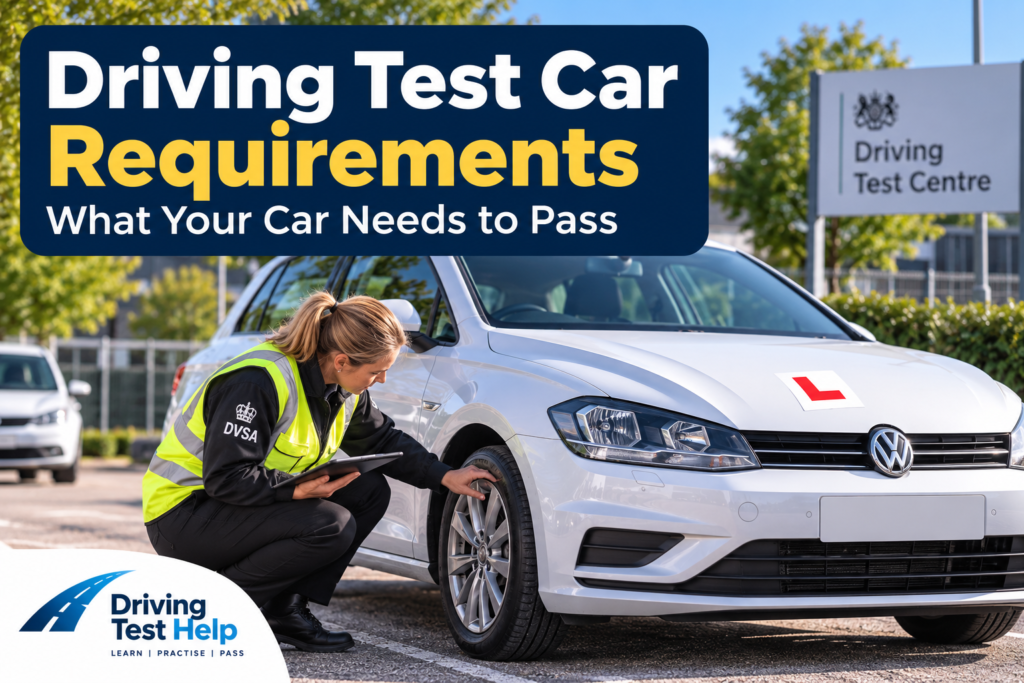
If you’re taking your practical driving test in your own car, it needs to meet certain requirements.
Your test can be cancelled and you may have to pay again if the car does not meet the rules, so it’s worth checking everything before test day. For your complete guide of what to check before test day check our Driving Test Checklist. And read our What To Take On Your Driving Test for what to bring on the day.
Most learners take their test in their driving instructor’s car, but you can use your own car if it meets the driving test car requirements.
What are the car requirements for a driving test?
Your car must:
- Be roadworthy
- Have no warning lights showing a safety problem
- Have tyres that are legal and free from damage
- Not have a space-saver spare tyre fitted
- Have an extra interior rear-view mirror for the examiner
- Have a passenger seatbelt and passenger head restraint for the examiner
- Be capable of reaching at least 62 mph
- Have an officially fitted mph speedometer
- Have L-plates on the front and rear
- Have four wheels
- Have a maximum authorised mass (MAM) of no more than 3,500kg
The extra interior mirror and passenger head restraint need to be properly fitted. Slip-on head restraints are not allowed.
Does my car need to be taxed and insured?
Yes.
If you’re using your own car for the driving test, it must:
Check with your insurance company that your policy covers you for the driving test.
Can I use my own car for my driving test?
Yes. You do not have to use your driving instructor’s car.
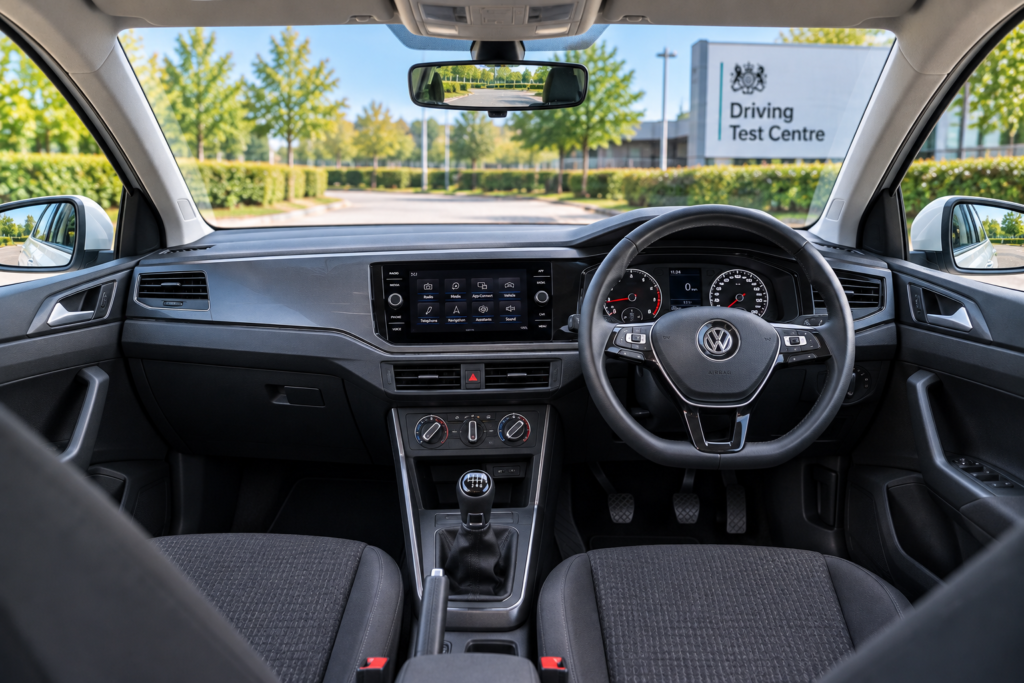
However, your own car must meet all of the driving test car requirements.
This can be particularly useful if you’ve been practising in your own car and are completely comfortable with it.
Want to know what to expect on the test day? Check out What Happens On Test Day for your complete guide.
Before using your own car, check that it has the required equipment and that it meets the DVSA rules.
Do I need dual controls?
No.
Your own car does not need to have dual controls for the driving test.
If you’re using a hire car, however, it must have dual controls as well as meeting the other requirements.
Do I need L-plates on my car?
Yes.
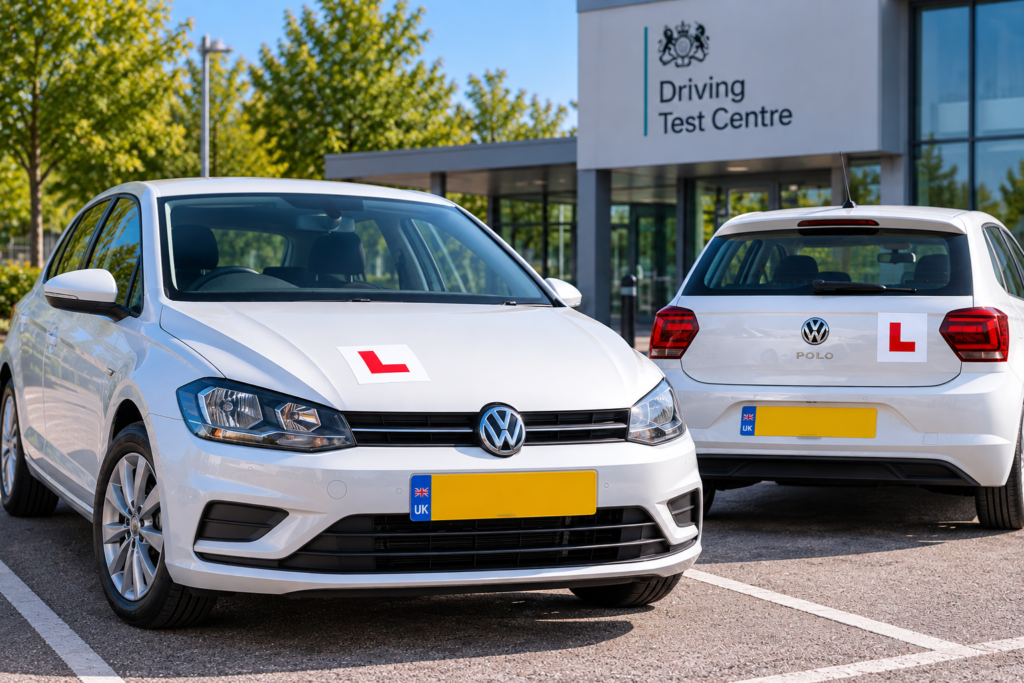
The car must display L-plates on both the front and rear.
In Wales, D-plates can be used instead.
Make sure the plates are fitted correctly and don’t obstruct your view or the examiner’s view.
What does my car need for the examiner?
The examiner needs to be able to sit safely in the passenger seat and see what’s happening around the vehicle.
Your car therefore needs:
-
- A passenger seatbelt
-
- A passenger head restraint
-
- An additional interior rear-view mirror for the examiner
The examiner also needs a clear view around the vehicle.
Can I use a manual or automatic car?
Yes.
You can take your test in either:
-
- A manual car
-
- An automatic or semi-automatic car
If you take your test in a semi-automatic car, the resulting licence restrictions are the same as for an automatic test.
What car features are allowed on the driving test?
Modern cars can have plenty of driver-assistance features and still be used for the test.
These can include:
-
- Electronic parking brake
-
- Hill-start assist
-
- Cruise control
-
- Speed limiter
-
- Parking sensors
-
- Parking cameras
-
- Lane assist
-
- Blind-spot monitoring
-
- Traffic-sign recognition
However, there are some features you cannot use during the test.
These include:
-
- Self-parking
-
- Tesla Autopilot
-
- Your own sat nav
What about tyres and warning lights?
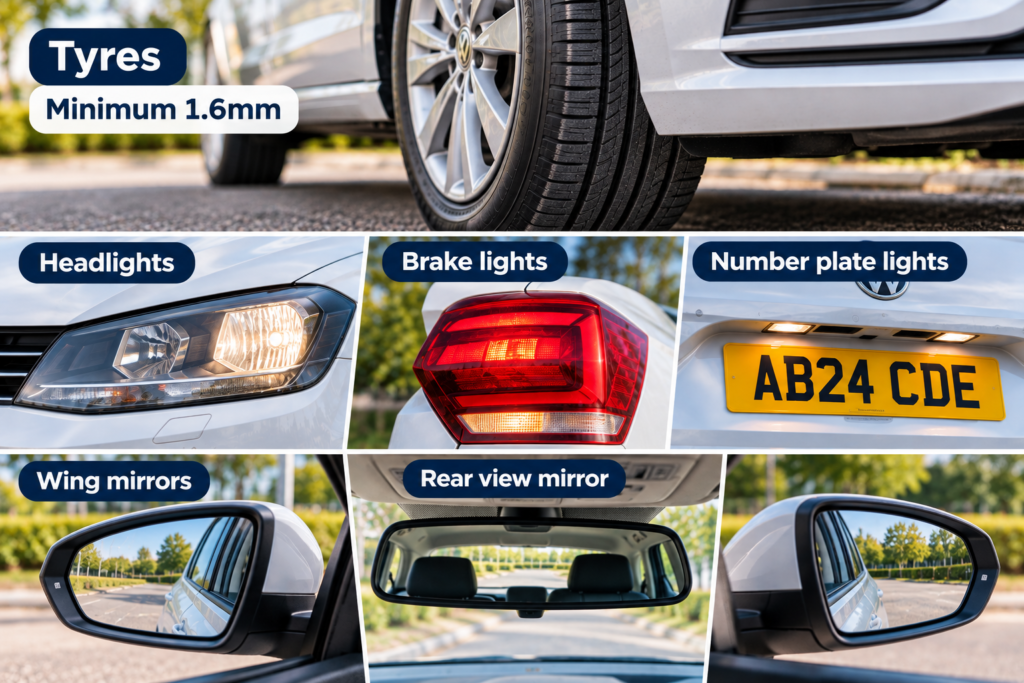
Before your test, check your tyres carefully.
They must have:
-
- No damage
-
- At least the legal tread depth
-
- No space-saver spare tyre fitted
You should also check your dashboard. Safety-related warning lights must not be showing, such as an airbag warning light.
It is worth doing these checks well before the test rather than discovering a problem when you arrive at the test centre.
Does the car need an MOT?
If your car is more than three years old, it must have a current MOT.
It must also be taxed and insured for the driving test.
Can I use a hire car?
Yes, but there are additional requirements.
A hire car can be used for the driving test if it:
-
- Has dual controls
-
- Meets all the other driving test vehicle requirements
Are there cars you cannot use for a driving test?
Yes.
Some vehicles cannot be used because they don’t give the examiner enough all-round visibility.
The current GOV.UK guidance lists certain vehicles that cannot be used, including some convertibles, the Smart Fortwo and Toyota iQ. The list can change, so if you’re unsure about a particular model, check with the DVSA before your test.
You should especially check with the DVSA if you’re planning to use a convertible or coupe.
Can I use a car with tinted windows?
Your windscreen and front side windows must meet the legal requirements for tinted windows.
There are no specific rules for the rear windows, but your test can be cancelled if the tint is so dark that the examiner cannot see clearly.
Should I clean my car before the test?
Yes. Give it a quick tidy before you arrive.
Remove unnecessary items and rubbish from places such as:
-
- Dashboard
-
- Footwells
-
- Door pockets
-
- Cup holders
-
- Seats
The car must also be smoke-free, meaning you cannot smoke in it immediately before or during the test.
Driving test car requirements checklist
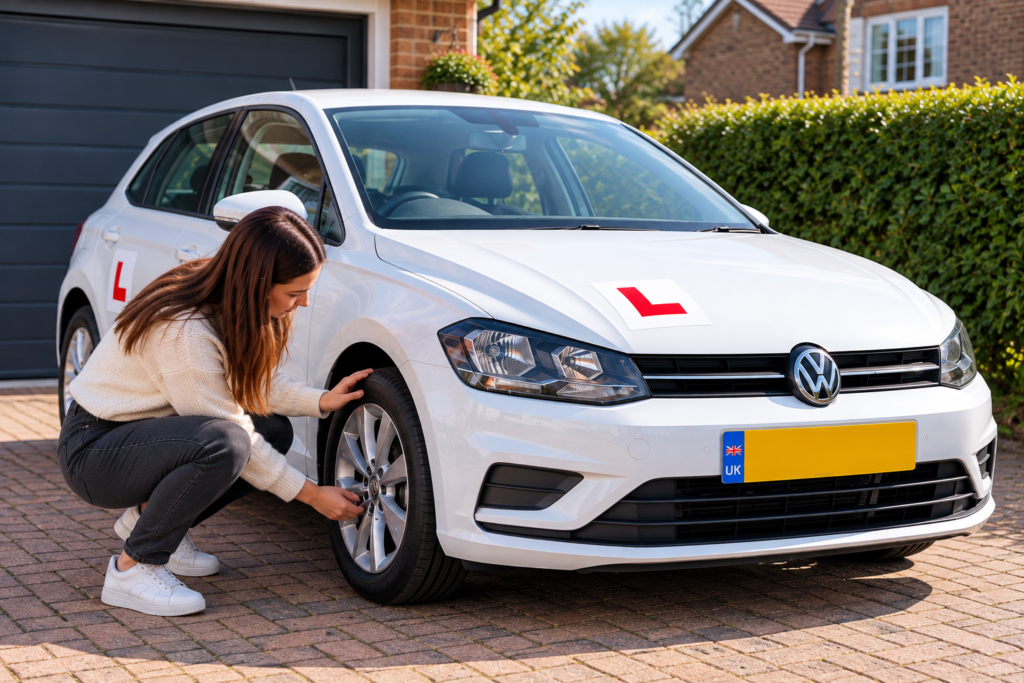
Before your test, check:
☐ Car is roadworthy
☐ No safety warning lights are showing
☐ Tyres are legal and undamaged
☐ No space-saver spare tyre is fitted
☐ Car has an extra interior mirror for the examiner
☐ Passenger seatbelt works
☐ Passenger head restraint is fitted
☐ Car can reach at least 62 mph
☐ Official mph speedometer is fitted
☐ L-plates are fitted front and rear
☐ Car has four wheels
☐ MAM is no more than 3,500kg
☐ Car is taxed
☐ MOT is current if required
☐ Insurance covers the driving test
☐ Car is clean and smoke-free
If you’re unsure whether your particular car can be used, check with your test centre or the DVSA before your test.
What happens if my car doesn’t meet the requirements?
This is the bit you really don’t want to discover on test day.
If your car doesn’t meet the required rules, your driving test can be cancelled and you may have to pay again.
It’s therefore worth checking your car a few days before the test, rather than relying on a quick check in the car park.
More help with your driving test
Once your car is ready, make sure you’re ready too.
-
- What to Take on Your Driving Test – check what you need to bring with you on the day.
-
- What Happens on a Driving Test – find out what happens from the start of your practical test to the result.
-
- Driving Test Checklist – run through the important things to check before test day.
-
- Driving Test Faults – understand driving faults, serious faults and dangerous faults.
-
- Driving Test Tips – practical advice to help you prepare and drive confidently.