Bay parking is one of the manoeuvres you could be asked to complete on your UK driving test.
Depending on the exercise selected, you may be asked to reverse into a parking bay and then drive out, or drive forward into a parking bay and then reverse out. The examiner will tell you which exercise you need to complete.
The aim isn’t to perform a perfect textbook manoeuvre. You need to show that you can control the car accurately, make effective observations and park safely without putting other people or vehicles at risk.
This guide explains both types of bay parking and gives you a straightforward method to practise. For more information on what to expect on test day read our What Happens on Your Driving Test guide.
What is bay parking?
Bay parking involves manoeuvring your car into a marked parking space in a car park.
There are two versions you could be asked to complete:
- Reverse into a bay, then drive out
- Drive forward into a bay, then reverse out
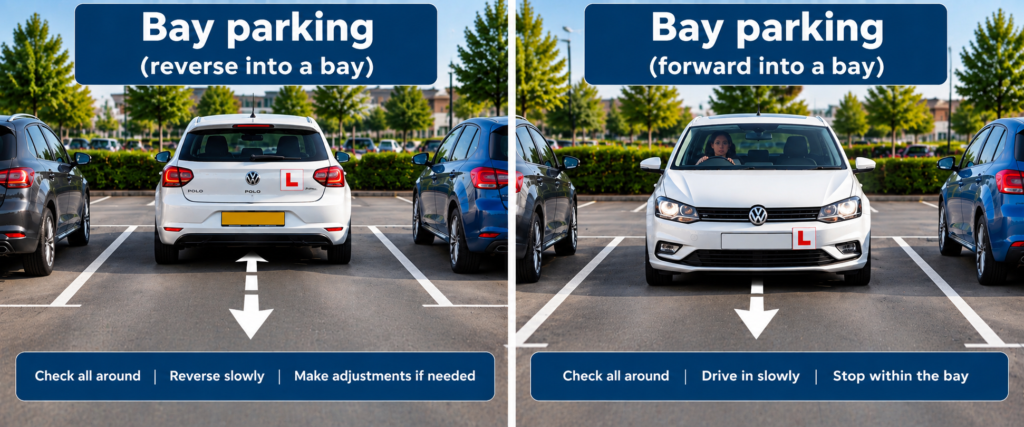
For the reverse parking exercise, you can choose a convenient bay and the examiner should not dictate which bay you use or exactly how you carry out the manoeuvre.
For forward parking, you’ll drive forward into a suitable bay and then reverse out when the examiner asks you to.
The important things are control, accuracy and effective all-round observation.
What happens on the driving test?
The examiner can ask you to complete the manoeuvre either at the beginning or towards the end of your test, depending on the exercise and the test centre.
Reverse into a bay
If you’re asked to reverse into a bay at the start of the test, you’ll first be asked to drive out of a bay to the left or right, where possible, and straighten the wheels before reversing into a convenient bay.
You can choose your own bay and your own method of getting into it. You can also make adjustments if you need to.
At the end of the test, you may instead be asked to drive into the test centre car park and reverse into a convenient bay before finishing.
Forward into a bay
For forward parking, you’ll be asked to drive forward into a suitable parking bay.
Once you’re satisfied with your position, the examiner will ask you to reverse out, either to the left or right depending on the layout of the car park.
You don’t have to use a particular reference point or follow one exact steering routine.
How to reverse into a parking bay
There isn’t one magic sequence that works perfectly in every car park. The position of the bays, the width of the car park and the size of your car can all change how the manoeuvre feels.
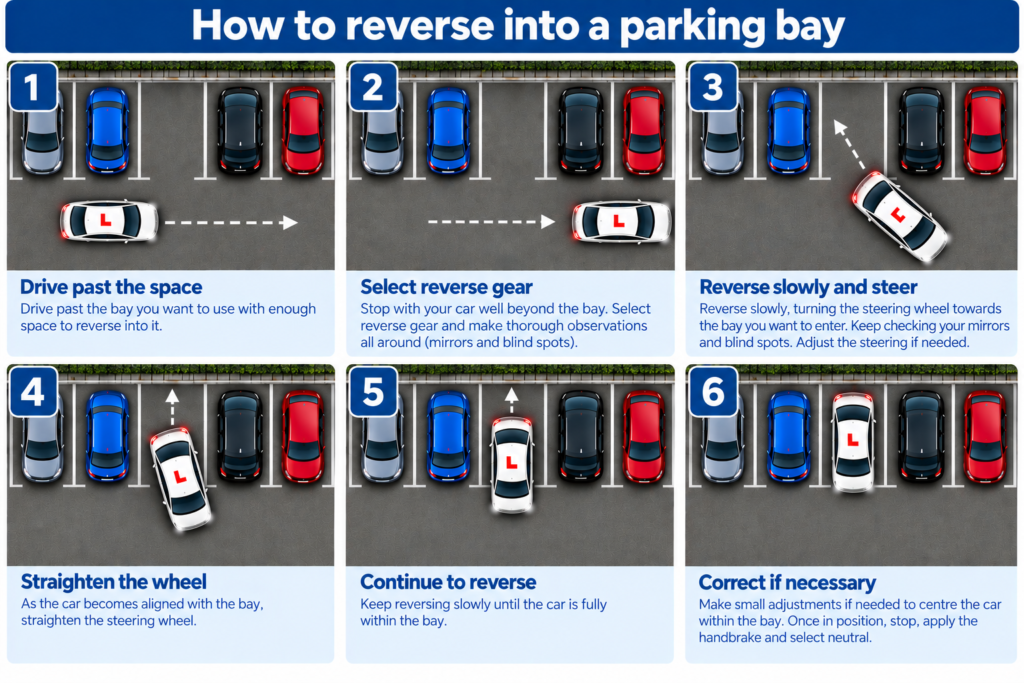
Instead, concentrate on what the car is doing and use your observations to guide you.
1. Choose a suitable bay
If you’re given a choice, look for a bay that gives you enough room to complete the manoeuvre safely.
Check the surrounding area before you start. Look for:
- Pedestrians
- Moving vehicles
- Vehicles approaching from either direction
- Shopping trolleys or other obstacles
- The position of nearby parked cars
Don’t start moving simply because the bay is empty. Make sure the area around your car is safe.
2. Set yourself up
Position the car so that you have enough room to manoeuvre towards the bay.
Take your time getting into position. A good starting position makes the rest of the manoeuvre much easier, you can position the car straight or at an angle.
You don’t need to copy a particular instructor’s reference point exactly. Your car may be different, and the layout of the car park may be different. Taking your own car for the test? Find out what the Driving Test Car Requirements are in our guide.
3. Check all around
Before reversing, make effective all-round observations.
Check your mirrors and blind spots and look around the car for pedestrians and vehicles.
Keep checking throughout the manoeuvre rather than doing one set of observations and then forgetting about them.
The examiner is assessing whether your observations are effective throughout the exercise.
4. Reverse slowly
Select reverse gear and begin moving slowly.
Use the clutch, brake and accelerator smoothly as appropriate for your car.
As the car starts to turn, keep checking where the car is going rather than concentrating only on the bay.
Slow speed gives you much more time to observe, think and make adjustments.
5. Watch the lines and surrounding cars
As you reverse, pay attention to the bay lines and the position of your car in relation to neighbouring vehicles.
Don’t become so focused on one line that you stop checking what’s happening around you.
If you realise you’re not going to enter the bay correctly, stop and adjust.
There is nothing wrong with making a correction when it’s done safely and under control.
6. Straighten the car
Once the car is properly inside the bay, straighten the steering and continue reversing carefully until you’re in a suitable final position.
You don’t need to obsess over being perfectly centred.
The important thing is that the car is safely positioned within the marked bay and can reasonably be left there.
7. Stop and secure the car
Once you’re happy with your position, stop the car and follow the examiner’s instructions.
Take another look around before making your next move.
How to forward park into a bay
Forward parking is slightly different because you drive into the bay rather than reversing into it.
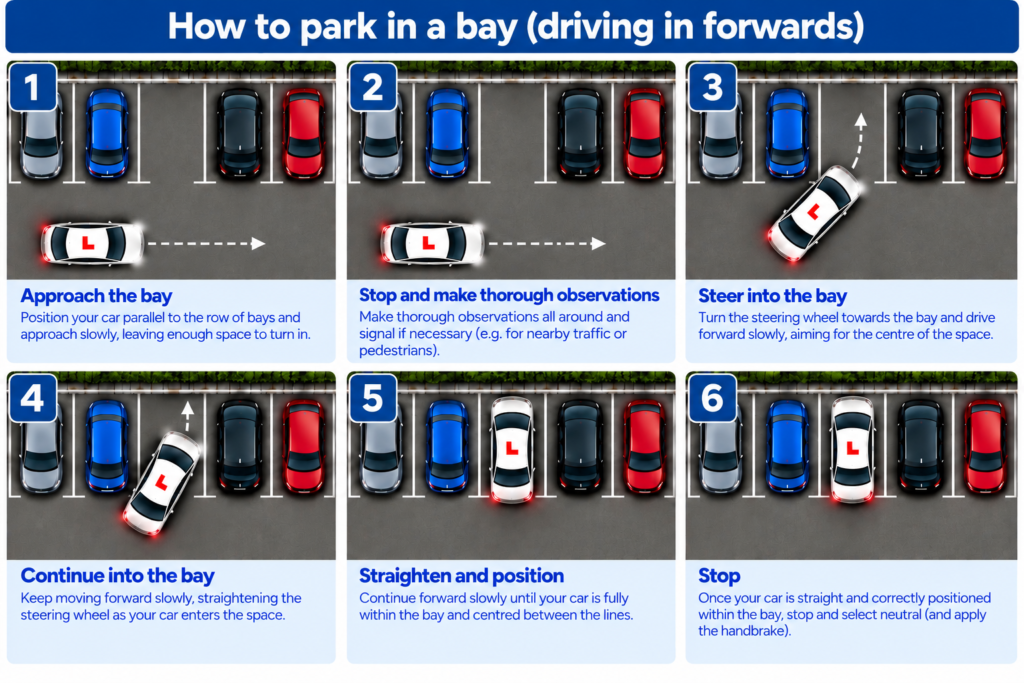
1. Choose your bay
The examiner will direct you towards a suitable area and you’ll normally have a choice of bay.
Look well ahead and check the surrounding area before committing to your bay.
2. Position the car
Give yourself enough room to steer into the bay.
Think about where the front and rear of your car will travel as you turn.
Remember that the back of the car will take a different path from the front.
3. Check your surroundings
Before turning into the bay, make sure it’s safe.
Continue checking your mirrors and surroundings as you manoeuvre.
Don’t rely entirely on your mirrors. Effective observation includes looking around for pedestrians and other vehicles.
4. Drive slowly into the bay
Turn smoothly and maintain a slow, controlled speed.
Watch the lines and the vehicles around you.
If your position isn’t right, don’t try to force the car into the bay. Stop and make a safe correction.
5. Finish within the bay
Your car should finish within the marked bay.
It doesn’t have to look absolutely perfect, but you need to leave the car in a safe and reasonable position.
Official guidance says that crossing a bay line while entering isn’t normally penalised by itself, but finishing outside the bay is unacceptable.
6. Reverse out safely
When the examiner asks you to reverse out, don’t rush.
Check all around the car before moving and continue observing as you reverse.
You may be asked to reverse to the left or right depending on the layout and any one-way system in the car park.
Can you correct your position?
Yes.
You don’t have to get the manoeuvre perfect in one movement.
If you realise you’re too close to a line or your angle isn’t right, you can stop and make a correction.
In fact, being able to recognise that your position needs adjusting is a useful driving skill.
The problem is not making a small correction. The problem is losing control, making excessive corrections or failing to observe properly while doing so.
The official examiner guidance specifically recognises repositioning as something that can occur during bay parking. A small correction can be recorded as a driving fault if it results from a loss of control or accuracy, while excessive repositioning caused by a major misjudgement can become more serious.
What observations do you need to make?
Observation is one of the biggest parts of bay parking.
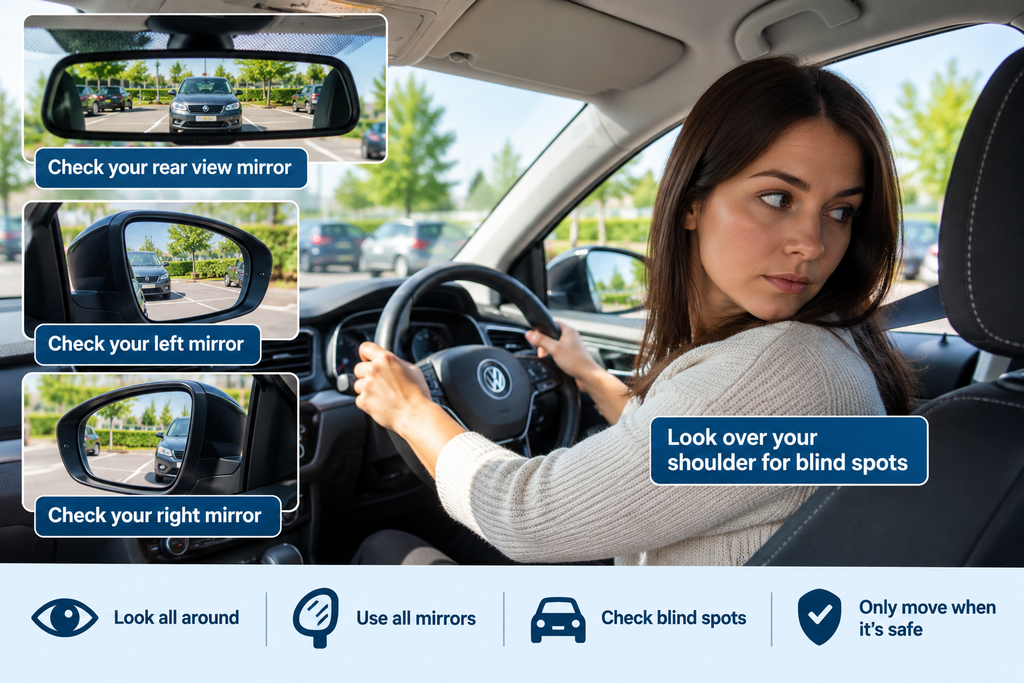
You need to know what’s happening around the whole car, not just where the bay lines are.
Keep checking:
- Interior mirror
- Door mirrors
- Blind spots
- Areas around the front of the car
- Areas behind the car
- Nearby pedestrians
- Other vehicles
Pay particular attention to pedestrians walking through the car park.
Don’t assume that because nobody was there when you started reversing, nobody can appear while you’re moving.
The examiner is looking for effective all-round observation throughout the manoeuvre.
How fast should you bay park?
Slowly enough that you remain completely in control.
There’s no prize for finishing quickly.
A slow manoeuvre gives you:
- More time to observe
- More time to react
- Better control of the car
- More opportunity to make a correction
- Less chance of hitting a vehicle or mounting a kerb
Don’t crawl so slowly that you’re struggling to control the car, but don’t rush because you feel under pressure from the examiner.
Take your time.
Common bay parking mistakes
Rushing
Trying to complete the manoeuvre quickly can lead to poor steering, missed observations and inaccurate positioning.
Looking only at the bay
The bay lines are important, but they’re not the only thing you need to watch.
Keep checking around the car.
Forgetting blind spots
Mirrors don’t show you everything.
Make sure your observations cover the areas you can’t see in the mirrors.
Turning the steering wheel the wrong way
This is particularly easy to do when you’re concentrating on several things at once.
If you’re unsure, slow down and think about where you want the car to go.
Over-correcting
One small correction is very different from repeatedly shuffling backwards and forwards because you’ve lost your position.
Finishing outside the bay
You need to finish within the marked bay. Parking outside it is unacceptable.
Forgetting to look before reversing out
Once you’re parked, don’t switch off your observations.
The reversing part of the forward-park exercise still requires effective all-round observation.
What faults can you get?
Bay parking is assessed mainly on control and observation.
A driving fault could result from things such as poor control, inaccurate positioning or ineffective observations.
The official examiner guidance gives examples including:
- Repositioning because of poor control or accuracy
- Poor coordination of the controls
- Unnecessary shunting forwards and backwards
- Ineffective observation
- Failing to check blind spots
- Looking but failing to react to other vehicles or pedestrians
- Finishing outside the bay
More serious problems can result in a serious or dangerous fault if the situation creates a greater risk or the examiner needs to intervene.
A small mistake doesn’t automatically mean you’ve failed.
How to practise bay parking
Don’t just practise the same bay in the same car park every time.
Once you’re comfortable, make your practice more varied.
Try:
- Different car parks
- Different bay widths
- Bays next to other vehicles
- Empty bays
- Reverse parking from different starting positions
- Forward parking and reversing out
- Parking when pedestrians are nearby
- Different times of day
The aim is to develop your ability to judge the car and its surroundings, rather than memorising one location.
If your instructor gives you a reference point that works for your car, that’s fine. Just make sure you understand why it works rather than relying on it blindly.
Bay parking checklist
Before you finish, remember:
☐ Choose a suitable bay
☐ Check all around the car
☐ Use your mirrors and blind spots
☐ Move slowly and stay in control
☐ Watch your position in relation to the lines
☐ Make corrections if necessary
☐ Keep checking for pedestrians and vehicles
☐ Finish within the bay
☐ Check all around before moving off again
Final bay parking tips
Don’t try to make the manoeuvre look perfect. Make it safe and controlled.
Take your time, keep your speed low and use your observations throughout.
If your first attempt isn’t quite right, don’t panic. Stop, reassess and make a safe correction.
The examiner isn’t looking for a particular steering routine. They’re looking for evidence that you can control the car, judge its position and deal safely with what’s happening around you.
Want to improve your overall manoeuvres?
Bay parking is just one of the manoeuvres you could be asked to complete. Need help with the parallel park or pull up on the right and reverse? Read our guides to Parallel Parking and Pull Up on the Right for more help.
For guidance on other useful manoeuvres like the turn in the road or reverse around a corner see our Driving Test Manoeuvres guide, or read our Driving Test Tips for advice on becoming a safer, more confident driver.
You can also read Driving Test Faults to understand how mistakes during your test are assessed, or Am I Ready for My Driving Test? if you’re wondering whether you’re ready to book.