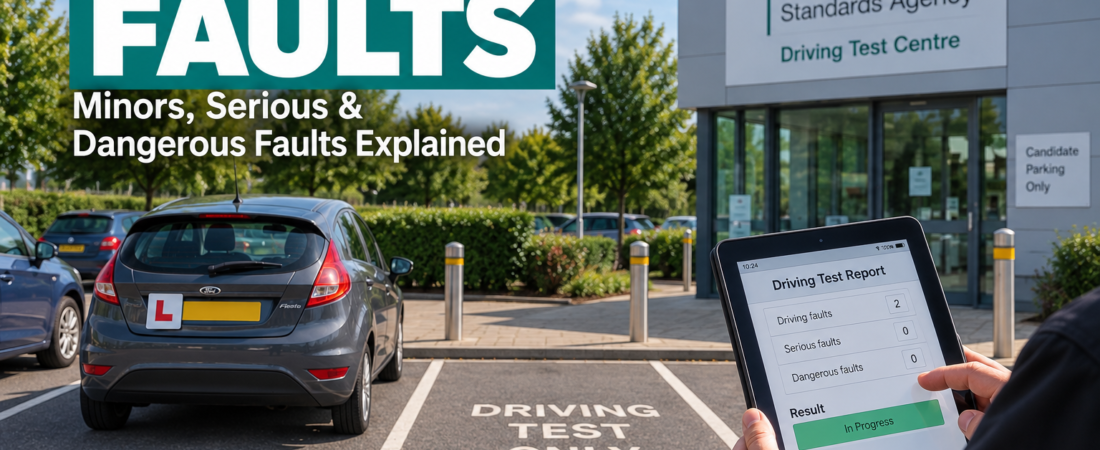
Making a mistake during your driving test doesn’t automatically mean you’ve failed.
Understanding how driving test faults are assessed can help you stay calm if something doesn’t go perfectly. There are three categories of fault you need to know about: driving faults, serious faults and dangerous faults. Want to know more about what to expect on test day? Read our What Happens On Your Driving Test guide.
You may have heard driving faults called “minors” and serious or dangerous faults called “majors”. These are common terms, but the official terminology is driving fault, serious fault and dangerous fault.
This guide explains how the faults work, how many minors you can have and still pass, what happens when you repeat a fault, and how your examiner records everything during the test
How many driving faults can you have on a driving test?
This is probably the question most learners want answered.
How many minors can you have on a driving test?
You can have up to 15 driving faults (often called minors) and still pass, provided you don’t receive a serious or dangerous fault.
However, one serious or dangerous fault means you fail, regardless of how many other faults you have.
If you receive 16 driving faults, you will fail the test.
You could therefore have 15 driving faults and still pass, provided none of them are assessed as serious or dangerous.
But don’t think of 15 as a target.
| Fault type | What it means | Result |
|---|---|---|
| Driving fault | A mistake that isn’t potentially dangerous | You can still pass |
| Serious fault | A potentially dangerous fault | Fail |
| Dangerous fault | An actual danger occurs | Fail |
A learner who collects several faults in the same area may be showing a pattern of driving that isn’t yet at the required standard.
What is a driving fault or minor?
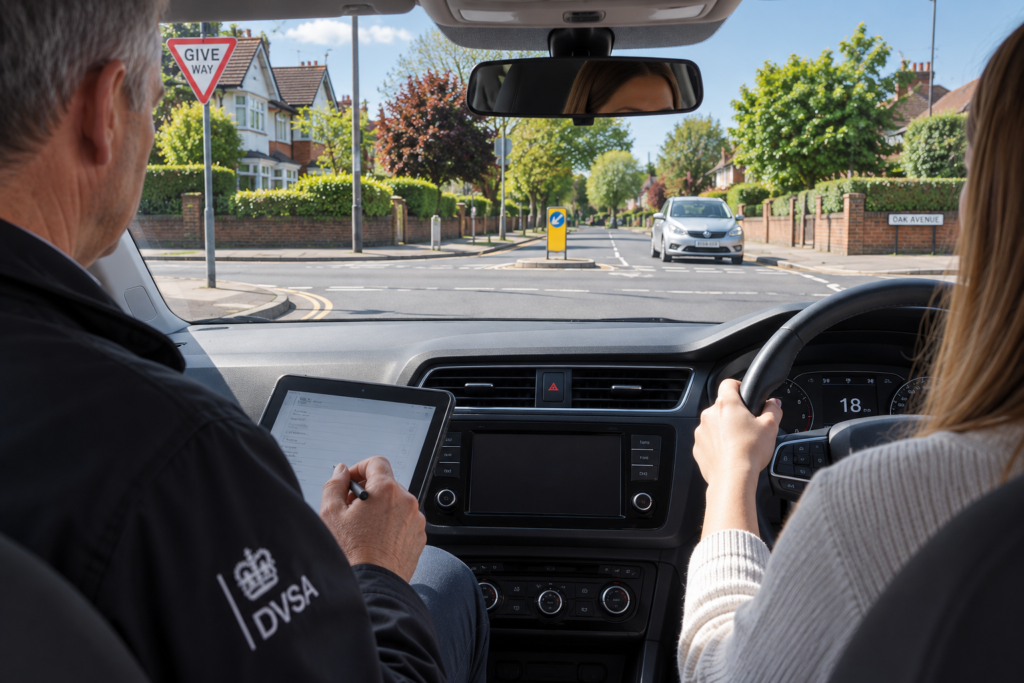
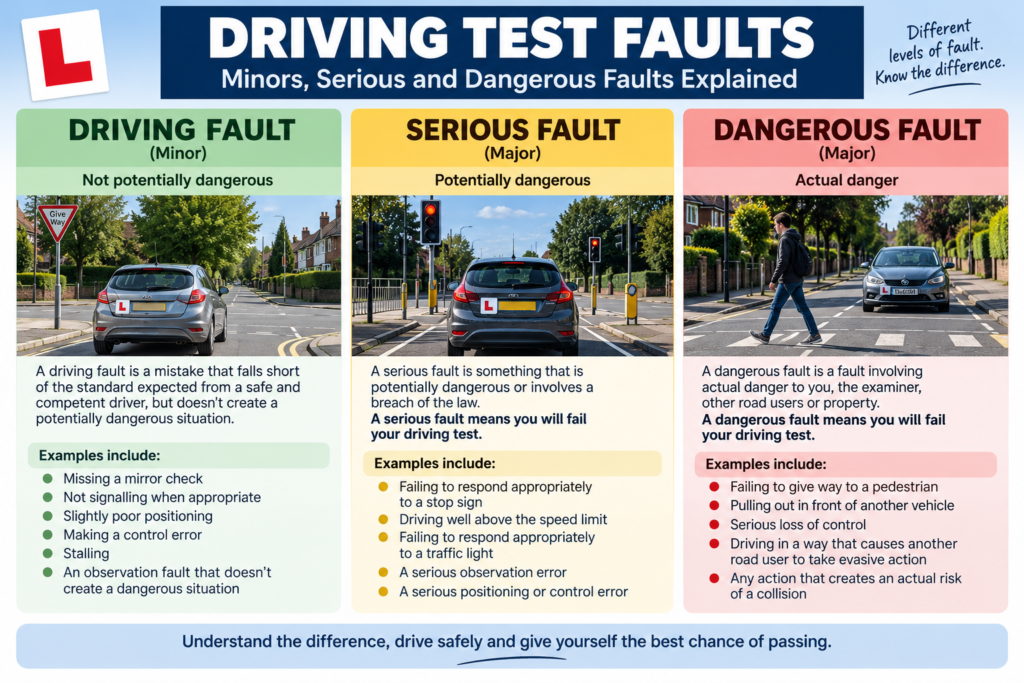
A driving fault is a mistake that falls short of the standard expected from a safe and competent driver, but doesn’t create a potentially dangerous situation.
These are commonly called minors.
Some examples could include:
-
- Missing a mirror check
-
- Not signalling when appropriate
-
- Slightly poor positioning
-
- Making a control error
-
- Stalling
-
- An issue with your use of speed
-
- An observation fault that doesn’t create a dangerous situation
The exact assessment depends on what happened, the circumstances and the effect of the mistake.
For example, stalling doesn’t automatically mean you’ve failed. The examiner considers what happened as a whole and records the appropriate fault if it is worthy of being recorded.
Can you get the same minor more than once?
Yes.
If you repeatedly make the same type of driving fault, the examiner can record it again.
However, repetition matters.
A single minor might be a relatively low-risk error. Repeatedly making the same mistake could demonstrate a pattern in your driving and, depending on the circumstances, could eventually be assessed as serious.
This is why it’s important not simply to think:
“I’ve only got a few minors, so I’m fine.”
The examiner is assessing the standard of your driving throughout the whole test.
What is a serious fault?
A serious fault is a fault that is potentially dangerous and results in a fail.
A serious fault means you fail your driving test.
Examples can include situations such as:
-
- Failing to respond appropriately to a stop sign
-
- Driving well above the speed limit
-
- Failing to respond appropriately to a traffic light
-
- A serious observation error
-
- A serious positioning or control error
The exact category depends on what happened and the level of risk involved.
A mistake that might be a driving fault in one situation could be serious in another if the circumstances make it potentially dangerous.
What is a dangerous fault?
A dangerous fault is more serious.
The official definition is a fault involving actual danger to you, the examiner, other road users or property.
Like a serious fault, one dangerous fault means you fail the test.
A dangerous fault could involve a situation where your driving creates an actual risk of a collision or puts someone in danger.
The important distinction is:
Driving fault: not potentially dangerous
Serious fault: potentially dangerous
Dangerous fault: actual danger
Driving test faults and the 16th fault rule
You may hear instructors talk about the “16th fault rule.”
This doesn’t mean your first 15 faults are automatically ignored.
Instead, examiners are trained to consider whether each mistake is worthy of being recorded as a driving fault.
The guidance explains that the examiner can effectively ask whether the fault would be serious enough to cause a failure if it were the 16th fault.
This helps examiners apply a consistent standard.
So don’t worry about trying to calculate how many faults you have during your test.
Your job is to keep driving safely.
What happens if you make a mistake?
This is one of the most important things to remember about driving test faults:
Don’t assume you’ve failed just because you’ve made a mistake.
If you want more practical advice on how to approach the test and avoid common mistakes, see our driving test tips guide. And if you’re wondering what you need to bring on the day see our What to Take on Your Driving Test guide.
You might stall.
You might take a wrong turning.
You might miss a signal.
You might make a small positioning error.
None of these automatically means you’ve failed.
If the mistake is not serious or dangerous, carry on driving and concentrate on what happens next.
Don’t let one mistake become three
This is where learners can sometimes make things worse.
For example, you might make a minor mistake approaching a junction.
You realise you’ve made an error.
You panic.
You stop concentrating on what’s happening ahead.
Then you make another mistake.
And another.
The original mistake may have been relatively minor. The bigger problem is allowing it to affect the rest of your driving.
Take a breath, reset and carry on.
If nerves are something you’re worried about, our guide to staying calm on your driving test has more practical advice.
What about stalling?

Stalling is a common worry among learners.
Stalling doesn’t automatically mean you fail your driving test.
The examiner assesses what happened and whether the stall resulted in a fault.
For example, if you stall safely while stopped and recover appropriately, it may be recorded as a driving fault.
However, if the stall creates a dangerous situation, the assessment can be more serious.
The same basic principle applies to many other mistakes:
It’s the situation and the effect of the mistake that matter, not simply the fact that something went wrong.
What about the show me, tell me questions?
The vehicle safety questions can also result in a driving fault.
You’ll be asked one “tell me” question at the beginning of the test and one “show me” question while you’re driving.
If you get one or both questions wrong, this results in one driving fault.
However, safety comes first.
If you’re asked to demonstrate something while driving, don’t allow the question to distract you from controlling the car and observing the road.
You can practise all of the questions in our complete Show Me Tell Me questions guide.
How are driving test faults recorded?
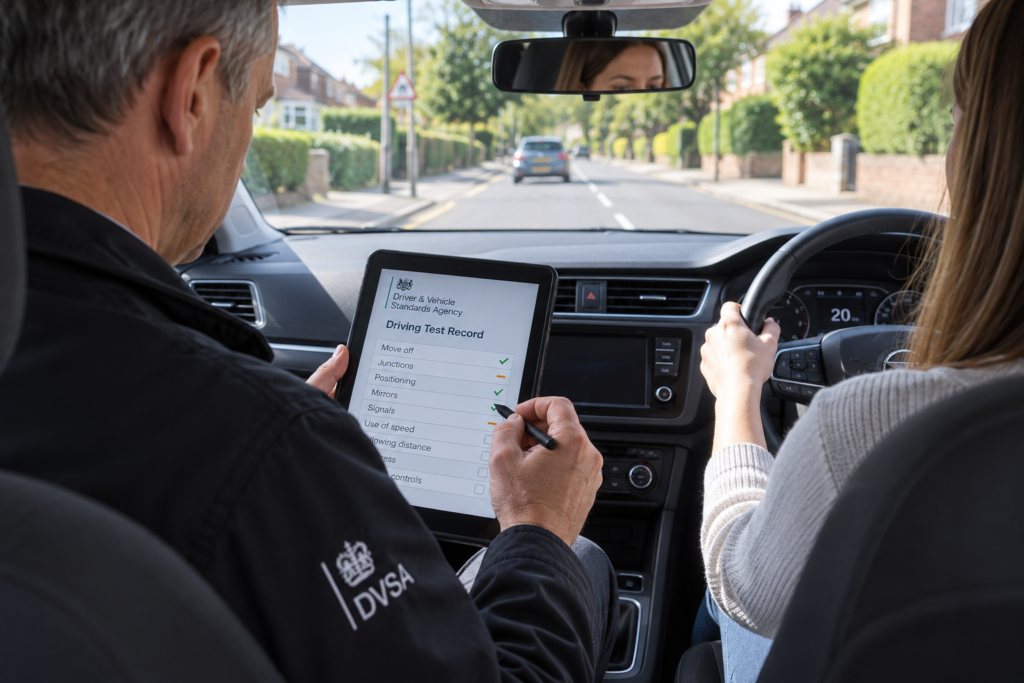
This is where things have changed from the old paper driving test marking sheet.
Your examiner uses a tablet
Driving examiners now record the result of the practical test digitally on a tablet, using a Digital Test Report.
The paper marking sheet that you may see online is therefore not normally what your examiner is physically using during your test. Paper forms are available if there is a problem with the tablet.
The examiner records faults under the relevant assessment categories as the test progresses.
They don’t necessarily mark something the instant it happens. Examiner guidance says they should assess the event and record the fault once they can make a confident judgement and it is safe to do so.
So if you notice your examiner tapping their tablet, don’t start trying to work out what they’ve just marked.
It might be a fault.
It might not.
And even if it is, you don’t know what category it has been given.
Keep driving.
For more information on how examiners mark the test see our Driving Test Marking Sheet guide.
What is on the driving test report?
Your test result records the faults you’ve made during the test.
The areas assessed include things such as:
-
- Move off
-
- Junctions
-
- Mirrors
-
- Signals
-
- Positioning
-
- Pedestrian crossings
-
- Clearance
-
- Response to signs and signals
-
- Use of speed
-
- Following distance
-
- Progress
-
- Control
-
- Awareness and planning
-
- Other aspects of the practical test
The examiner may also record whether they had to take action to avoid an incident.
Can you pass with 10 minors?
Yes.
You can pass with 10 driving faults, provided you have no serious or dangerous faults.
Can you pass with 15 minors?
Yes.
You can pass with 15 driving faults, provided you have no serious or dangerous faults.
The same applies to 11, 12, 13 or 14 driving faults.
Can you fail with just one fault?
Yes.
If you make a serious or dangerous fault you would fail, even if you had no minors.
The number of minors on its own doesn’t determine whether you pass.
However, don’t fall into the trap of thinking:
“I’ve got 15, so I’m allowed 15.”
The test is about demonstrating that you are a safe and competent driver.
If you’re regularly making mistakes, particularly in the same area, you may need more practice before you’re genuinely ready for your test.
What happens at the end of the test?
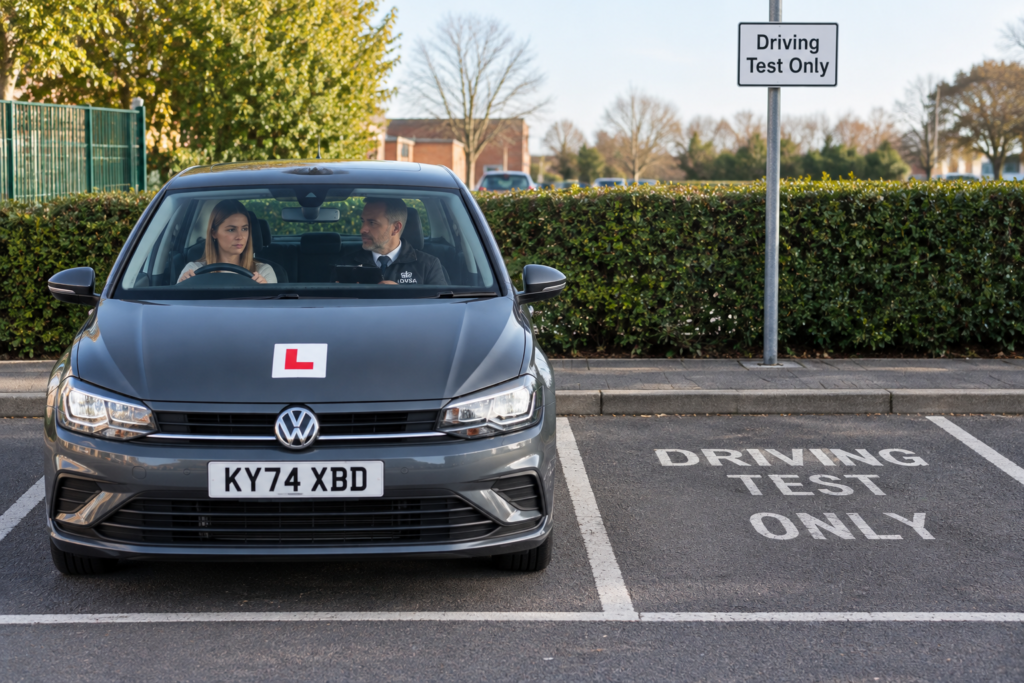
When your driving test finishes, the examiner will tell you whether you’ve passed or failed.
They will also tell you about the faults you’ve made.
If you’ve passed, you’ll receive your pass certificate and the examiner will explain the next steps.
If you’ve failed, the examiner will explain the result and you’ll receive information showing the faults recorded during your test.
Try to listen to the feedback rather than immediately focusing on the fact that you’ve failed.
Knowing exactly what went wrong gives you something useful to work on before your next test.
Don’t count faults during your test
One of the worst things you can do is spend the test trying to keep a running tally.
You make a mistake.
You think:
“That’s one.”
Then another happens.
“That’s two.”
Before long, you’re mentally keeping score instead of concentrating on the road.
You don’t know exactly how the examiner has assessed each situation anyway.
Your only job is to continue driving safely.
How to reduce your driving test faults
The best way to reduce faults isn’t to memorise a list of things the examiner might mark.
It’s to understand why the faults happen.
For example:
If you get observation faults
Practise looking earlier and developing better awareness of what’s happening around you.
If you get positioning faults
Work on planning your lane position earlier rather than correcting it at the last moment.
If you get speed faults
Practise recognising changes in speed limits and adjusting your speed early.
If you get control faults
Spend time becoming more comfortable with the clutch, accelerator, steering and other controls.
If you repeatedly make the same fault
Don’t simply hope it won’t happen during the test.
Work out what’s causing it and practise until the problem becomes much less likely.
If you’re still unsure whether you’re ready for your test, our Am I Ready for My Driving Test? guide can help you assess where you are.
Your driving test faults checklist
Before your test, make sure you understand:
☐ You can pass with up to 15 driving faults
☐ 16 driving faults means you fail
☐ One serious fault means you fail
☐ One dangerous fault means you fail
☐ Driving faults are commonly called minors
☐ Serious and dangerous faults are commonly called majors
☐ Repeated driving faults can become more serious
☐ Stalling doesn’t automatically mean you fail
☐ A mistake doesn’t automatically mean you’ve failed
☐ Examiners record faults digitally on a tablet
☐ Your job is to keep driving safely rather than counting faults
For a wider pre-test checklist covering what to take and what to expect on the day, see our Driving Test Checklist.
Final thoughts
Understanding driving test faults can take some of the mystery out of the practical test.
You don’t need to drive for 35 minutes without making a single mistake. You need to demonstrate that you can drive safely and competently.
If you make a minor mistake, deal with it and move on.
If you notice the examiner tapping their tablet, don’t panic.
And if something goes wrong, remember that the next few minutes of your test still matter.
Stay focused on the road, keep making safe decisions and give yourself the best chance of finishing strongly.
You may also find helpful
Driving Test Marking Sheet
See how examiners record faults and assess your driving during the test.Driving Test Checklist
Make sure you know what to take and what to expect on test day.Am I Ready for My Driving Test?
Work through the key areas to consider before booking your test.