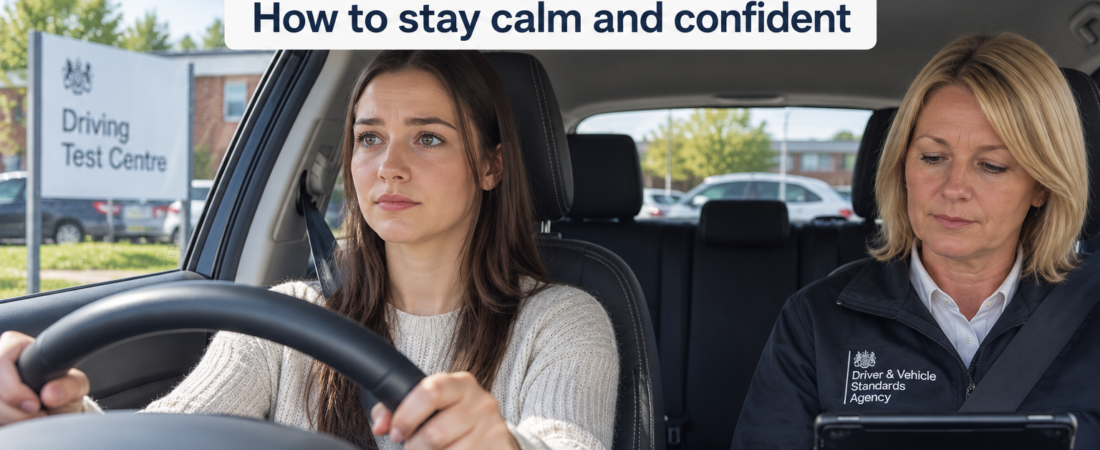
Feeling nervous about your driving test is completely normal. Even learners who drive confidently during their lessons can find that test day feels different.
You know someone is sitting beside you assessing your driving, the result matters to you, and suddenly every little mistake can feel much bigger than it really is.
The good news is that driving test nerves don’t mean you’re not ready. With the right preparation and a few strategies for managing nerves, you can give yourself the best chance of driving the way you normally do.
This guide explains how to deal with driving test nerves before and during your UK practical driving test.
Why do driving tests make you nervous?
There are several reasons why learners experience nerves before a driving test.
You might be worried about:
- Failing
- Making a mistake
- Forgetting something you’ve practised
- The examiner judging your driving
- Getting a manoeuvre you don’t like
- Stalling
- Meeting difficult traffic
- Going blank during the test
- Having to take another test if you fail
Sometimes the fear of making a mistake becomes the biggest problem.
You make a small error, assume you’ve failed, become more nervous and then find it harder to concentrate.
Understanding this cycle is important because one mistake does not automatically mean you’ve failed.
Driving test nerves are normal
One of the most useful things you can remind yourself is that being nervous doesn’t mean you’re going to fail.
You don’t need to feel completely calm before your test.
In fact, trying to force yourself to feel absolutely relaxed can sometimes make you more anxious.
Instead, accept that you’ll probably feel nervous and focus on what you can control.
You might have butterflies in your stomach, sweaty hands or a faster heartbeat.
That’s okay.
Your aim isn’t to eliminate every nervous feeling. It’s to drive safely despite feeling nervous.
How to calm driving test nerves
There are several simple things you can do to reduce driving test nerves and feel more in control on the day. Good preparation, getting organised and giving yourself time to relax can all help.
Make sure you’re actually ready
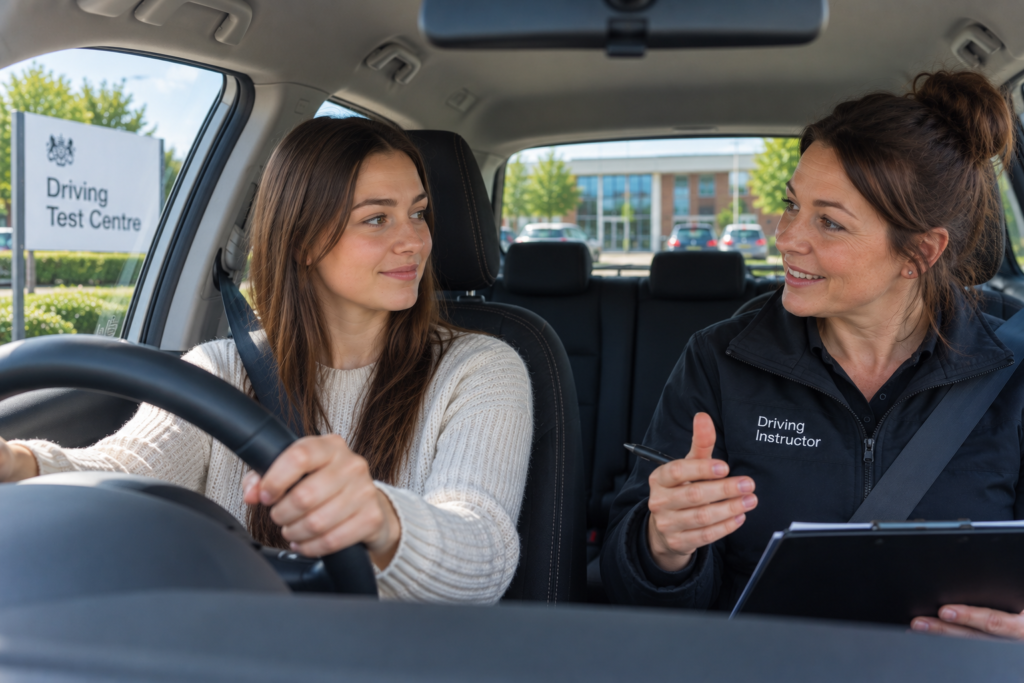
Preparation is one of the best ways to reduce driving test nerves.
If you’re genuinely ready for your test, you should be able to drive safely without relying on your instructor constantly prompting you.
You should be comfortable with:
- Junctions
- Roundabouts
- Meeting and passing traffic
- Pedestrian crossings
- Following road signs
- Independent driving
- Changing lanes
- Appropriate use of mirrors
- Speed management
- Manoeuvres
- Moving off safely
- Dealing with unexpected situations
You should also have experience driving on different types of roads and in different traffic conditions.
The more familiar these situations become, the less likely they are to feel overwhelming during your test.
If you’re constantly wondering whether you’re ready, speak honestly with your instructor rather than booking a test simply because you feel you should.
If you’re still unsure, our Am I Ready For My Driving Test? guide can help you work through the key things to consider before booking.
Don’t try to learn everything the night before
Cramming isn’t just for exams at school.
Some learners spend the evening before their driving test trying to practise every manoeuvre, memorise every possible test route and watch endless driving test videos.
This can actually make your nerves worse.
By the night before your test, the hard work should already have been done.
You don’t need to suddenly become a better driver overnight.
Instead, have a calm evening, get everything ready and give yourself a chance to sleep properly.
Get your test-day essentials ready
Removing unnecessary stress from the morning can make a surprisingly big difference.
Before going to bed, make sure you know where everything is. Our Driving Test Checklist covers the main things you need to have ready for test day.
Check that you have:
- Your driving licence
- Your test appointment details
- Access to a suitable car
- Any glasses or contact lenses you normally need for driving
- Everything else your instructor has advised you to bring
Make sure the car is ready too.
You don’t want to discover a problem five minutes before leaving home.
Get a good night’s sleep
It’s tempting to stay awake worrying about the test.
You might lie there thinking:
“What if I fail?”
“What if I stall?”
“What if I can’t do the manoeuvre?”
Try not to let your brain turn the evening into a full-scale driving-test cinema.
You don’t need perfect sleep to pass your test, but getting a reasonable night’s rest can help you concentrate and react to situations more effectively.
If you struggle to sleep because you’re nervous, don’t panic about that either.
Resting quietly is still better than spending the whole night checking the clock.
Don’t arrive too early
You don’t want to be rushing into the test centre, but arriving excessively early can also give your nerves more time to build.
Aim to arrive with enough time to settle yourself without spending a long period sitting around thinking about everything that could go wrong.
Your instructor can help you decide what works best based on your test centre and journey.
Have a short drive beforehand
If your instructor recommends it, a short drive before the test can be useful.
It gives you a chance to settle into the car and get your normal driving routine going.
You might practise a few things that you commonly encounter around the test centre, but don’t turn the warm-up into another full driving lesson.
The purpose is to settle your brain into driving mode, not discover ten new things you’re worried about.
Use your normal driving routine
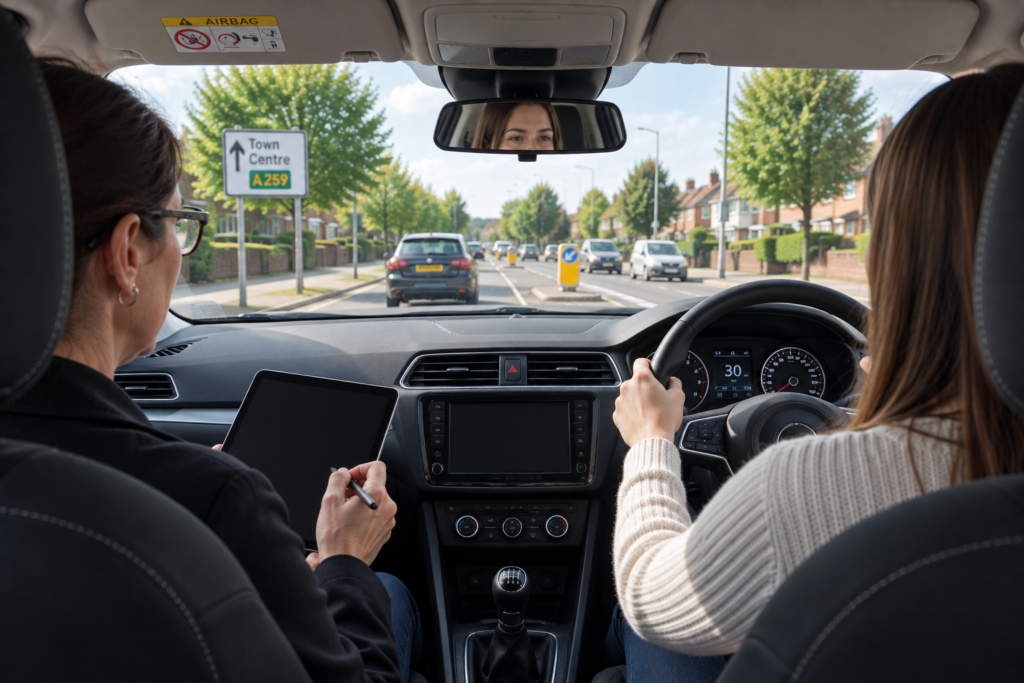
One of the biggest mistakes nervous learners make is trying to drive differently because they’re being tested.
Don’t suddenly change everything you’ve been taught.
Use the routines you’ve developed during your lessons.
For example:
Mirrors → signal → position → speed → look
Use whatever routines and habits your instructor has taught you.
For more practical advice on preparing for the test and giving yourself the best chance of passing, see our driving test tips guide.
The examiner isn’t looking for a completely different version of your driving.
They’re assessing whether you can drive safely and competently on your own.
What if you stall?
Stalling is one of the most common fears before a driving test.
But stalling doesn’t automatically mean you’ve failed.
If you stall, deal with it safely and continue.
For example:
- Secure the car.
- Restart the engine.
- Check what’s happening around you.
- Move off safely when appropriate.
- Continue with the test.
Don’t spend the next five minutes thinking:
“I’ve failed. What’s the point now?”
You don’t know how the examiner has assessed the situation.
A mistake has happened.
Deal with it and move on.
What if you make a mistake?
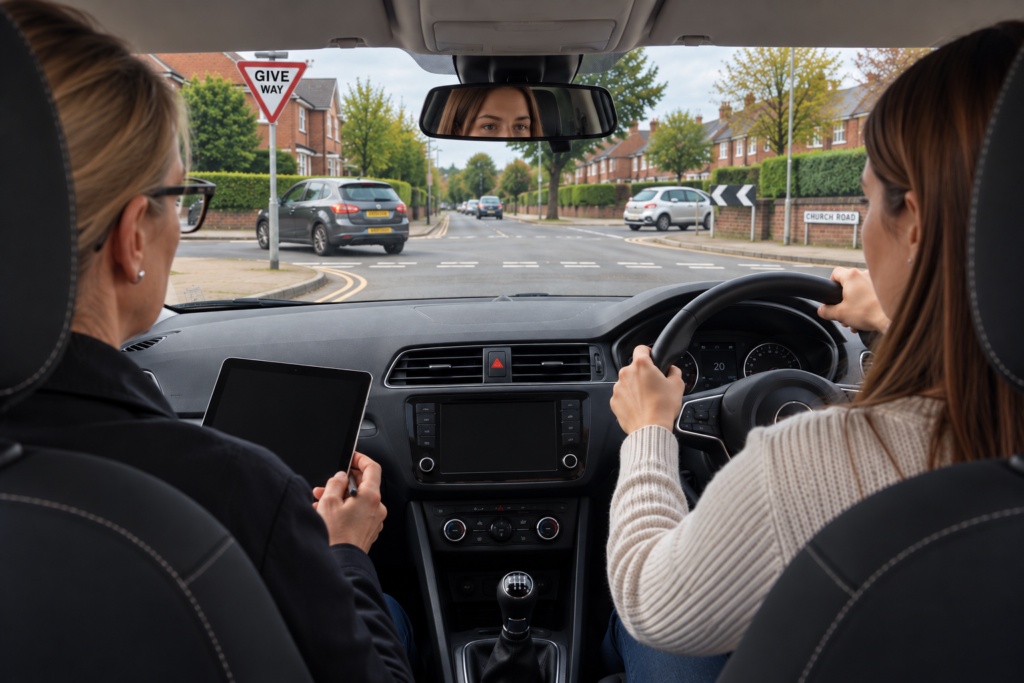
This is perhaps the most important advice for anyone experiencing driving test nerves.
Don’t mentally fail yourself before the examiner has finished assessing you.
You might miss a signal.
You might take the wrong direction.
You might position the car slightly incorrectly.
You might make a control error.
That doesn’t automatically mean the test is over.
Understanding how driving test faults are assessed can help put individual mistakes into perspective.
If you make a mistake, ask yourself:
“What do I need to do safely now?”
That’s it.
Don’t spend the next minute analysing what just happened.
The road in front of you is more important than the road behind you.
Don’t count your faults
Trying to keep track of your driving faults during the test is a terrible use of your brainpower.
You don’t know exactly what the examiner has recorded, how they’ve assessed it or whether something was recorded at all.
If you spend the test thinking:
“That’s one minor.”
“That’s definitely another one.”
“I’ve probably got 10 now.”
your attention isn’t where it needs to be.
Forget the running total.
Your job is to keep driving safely.
You can find out what was recorded when the test is finished.
Take your time
Nerves can make you rush.
You might approach a junction too quickly, move off before you’ve properly checked, or make decisions without giving yourself enough time to assess what’s happening.
You don’t need to drive slowly.
You do need to give yourself enough time to make safe decisions.
Look well ahead.
Plan early.
If you need an extra moment to assess a situation, take it when it is safe to do so.
Good observation and planning can make your driving feel much more controlled.
Use breathing to settle yourself
If you notice your nerves increasing before the test, try deliberately slowing your breathing.
Take a slow breath in, then breathe out gently.
You don’t need a complicated breathing technique.
The purpose is simply to interrupt the cycle of tense thoughts and give yourself a moment to reset.
You can also relax your grip on the steering wheel and drop your shoulders.
You may not realise how much tension you’re holding in your body until you deliberately let some of it go.
Remember that the examiner is human
It can feel intimidating having an examiner sitting beside you.
But they’re not sitting there hoping you’ll make mistakes.
Their job is to assess your driving consistently and fairly.
You don’t need to impress them with perfect driving.
You need to demonstrate that you can drive safely and independently.
Think of the examiner as someone assessing the drive rather than someone judging you as a person.
Failing a driving test doesn’t mean you’re a bad driver.
It simply means that, on that particular test, you didn’t demonstrate the required standard.
What if the examiner seems serious?
Don’t try to read the examiner’s facial expressions.
Some examiners talk very little.
Some may make notes or use their tablet during the test.
Some may have a naturally serious expression.
None of this tells you whether you’re passing or failing.
The examiner’s job isn’t to encourage you throughout the drive.
So don’t interpret silence, tapping on the tablet or a serious expression as a sign that you’ve failed.
Keep your attention on the road.
What if something unexpected happens?
Real driving doesn’t happen in a controlled bubble, and neither does the practical test.
You could encounter:
- A road closure
- An unusual junction
- An emergency vehicle
- A pedestrian stepping towards the road
- A cyclist
- Heavy traffic
- A vehicle making an unexpected manoeuvre
- Temporary traffic lights
You aren’t expected to predict everything.
You’re expected to respond safely.
If something unexpected happens, slow down or stop when appropriate, observe what’s happening and make a safe decision.
Your ability to deal with the unexpected is actually part of demonstrating that you’re ready to drive independently.
Don’t compare yourself with other learners
You might know someone who passed first time.
You might know someone who failed four times.
Neither tells you what will happen to you.
Everyone learns at a different pace and everyone’s test is different.
Try not to turn someone else’s result into a prediction of your own.
Your driving is what matters.
What to do immediately before your test
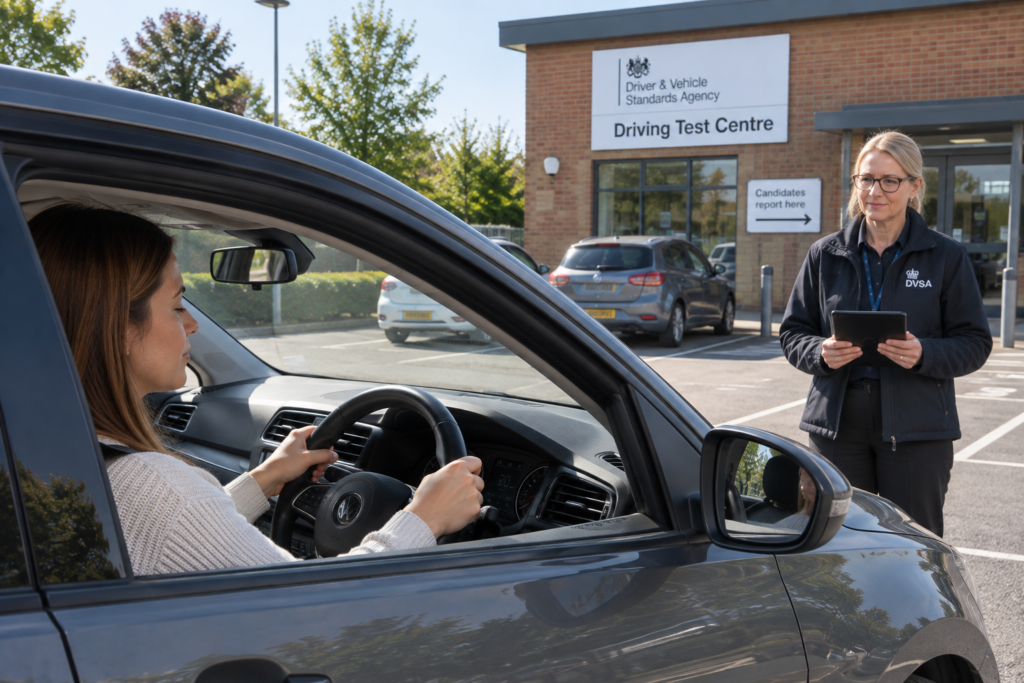
When you’re sitting in the car waiting for the test to begin, keep things simple.
Don’t suddenly start running through every possible fault in your head.
Instead:
- Get comfortable
- Adjust your seat and mirrors
- Take a steady breath
- Listen carefully to the examiner
- Focus on the first part of the drive
- Use your normal routines
You don’t need to think about the entire 35-minute test.
Just concentrate on the next thing you need to do.
A simple mindset for your driving test
Rather than thinking:
“I have to pass.”
Try thinking:
“I’m going to drive safely and show them how I normally drive.”
That’s a much more useful goal.
You can’t control whether traffic behaves strangely.
You can’t control what manoeuvre you’re asked to do.
You can’t control exactly what happens during the test.
But you can control your observations, planning, speed, positioning and decisions.
Focus on those.
Driving test nerves checklist
Before your test, make sure you’ve:
☐ Had enough practice
☐ Driven independently without constant prompting
☐ Practised different roads and traffic conditions
☐ Practised all the manoeuvres
☐ Prepared your car and documents
☐ Planned your journey to the test centre
☐ Had a reasonable night’s rest
☐ Allowed enough time to arrive
☐ Avoided cramming the night before
☐ Accepted that you may feel nervous
☐ Reminded yourself that one mistake doesn’t automatically mean you’ve failed
☐ Planned to focus on safe driving rather than counting faults
Final thoughts on driving test nerves
You don’t have to walk into your driving test feeling completely fearless.
You just need to be prepared enough to drive safely while you’re nervous.
The nerves might still be there when you start the engine.
That’s okay.
Take your time, use the routines you’ve practised and concentrate on what’s happening around you.
If you make a mistake, deal with it and carry on.
Don’t try to predict your result halfway through the test.
And don’t forget that you are there to demonstrate your normal driving, not perform a perfect drive.
For more driving test preparation
Once you’ve got your nerves under control, it can help to work through the practical side of your preparation too.
Other useful information