If you’re preparing for your practical driving test, you might be wondering what the driving test marking sheet actually looks like and how your examiner records mistakes.
You may have seen older examples of the DVSA driving test marking sheet online. However, there’s an important update to know about: driving examiners now record driving test results digitally on a tablet using a Digital Test Report. The change was introduced in 2024 and did not change how the test is assessed or how faults are classified.
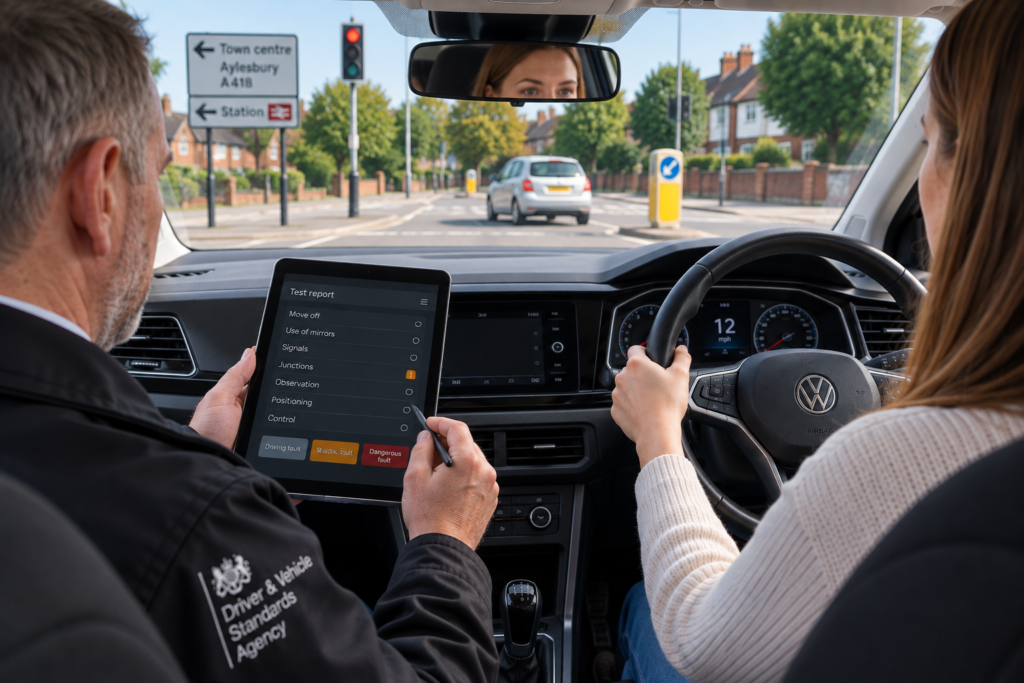
What does the driving test examiner’s sheet look like?
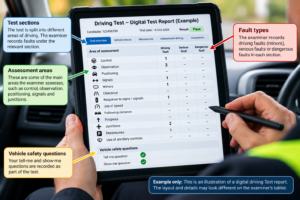 *ILLUSTRATIVE EXAMPLE ONLY. Not an official DVSA document. This graphic is for guidance only and does not reproduce the actual Digital Test Report.
If you’re looking for a driving test examiner sheet, the UK driving test marking sheet is now recorded digitally on a tablet using the Digital Test Report. The report records the faults identified during your practical driving test under the relevant assessment headings. Although you may still find older paper-style marking sheets online, examiners now use the digital system to record results.
So what exactly is your examiner recording during the test?
Here’s how the system works and what your result means.
Driving Test Marking Sheet vs Digital Test Report
You may still see the terms driving test marking sheet, DVSA driving test marking sheet or driving test marking scheme used online. Today, examiners record your result digitally on a tablet using a Digital Test Report.
The change affected how the result is recorded, not how your driving is assessed.
Is there still a driving test marking sheet?
The short answer is yes, but it is now digital.
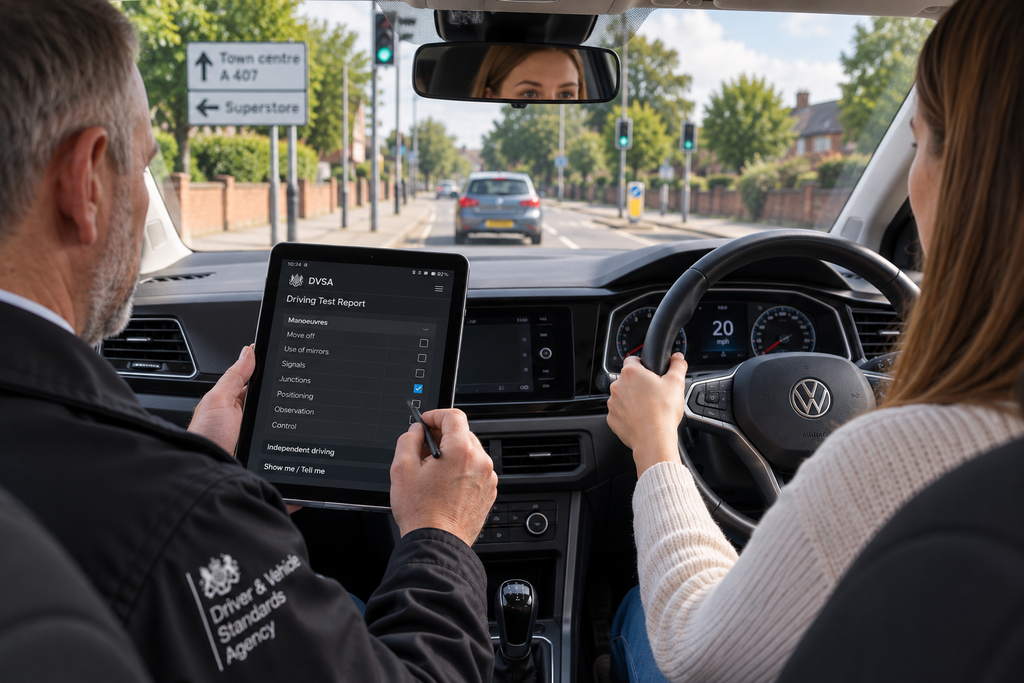
The old paper-style marking sheet is no longer the normal way examiners record your result. DVSA guidance says examiners now record driving test results digitally on a tablet.
The digital version is called the Digital Test Report.
The important thing for learners is that the change was mainly about how the result is recorded, not how you are assessed. DVSA confirmed that the move to digital recording did not change the way tests are conducted or how faults are assessed.
So if you’ve found an old image of a paper marking sheet while searching online, don’t worry if your examiner’s tablet looks completely different.
What Does the Examiner Mark on the Driving Test?
Your examiner assesses your driving throughout the practical test.
They are looking at things such as:
- how you control the car
- your use of mirrors
- your signalling
- your positioning
- your speed
- your progress
- your awareness and planning
- your judgement
- your response to signs and signals
- your driving at junctions
- your clearance from obstructions
- your following distance
- your manoeuvres
- your use of ancillary controls
- your vehicle safety questions
These areas appear under different headings on the Digital Test Report.
If you want to understand the different areas of driving the examiner is assessing, our Driving Test Tips guide covers the key things to focus on when preparing for your test.
The examiner doesn’t simply give you a mark out of 100. Instead, they record individual faults when your driving falls below the required standard.
DVSA guidance explains that once an examiner has identified and assessed a fault, it is recorded under the appropriate heading on the Digital Test Report.
What are driving faults?
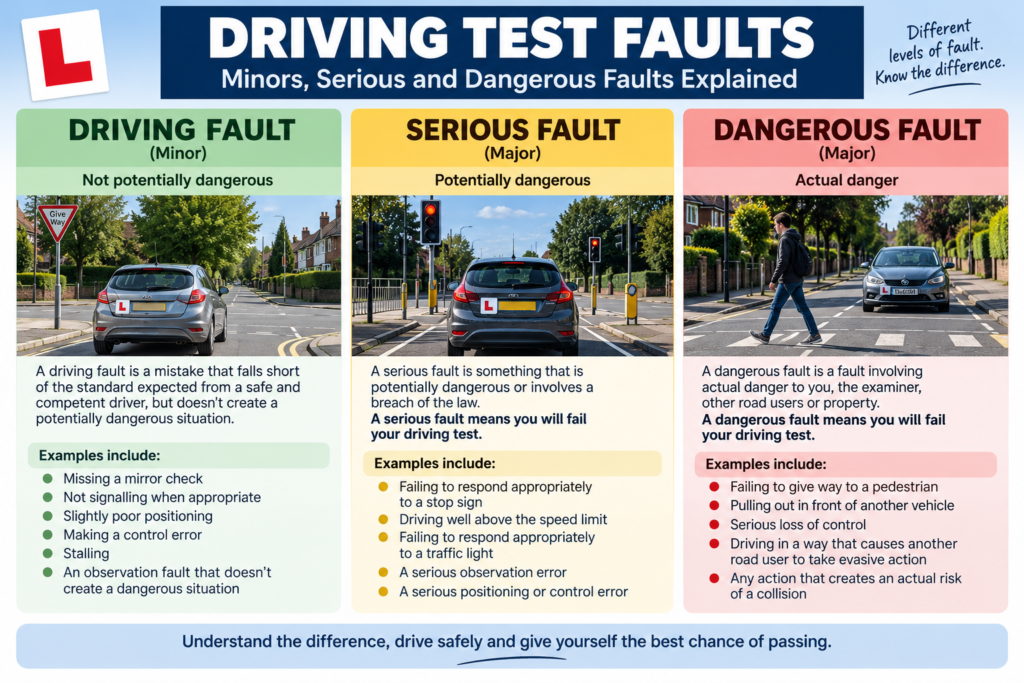
A driving fault, often called a minor, is a fault that does not meet the standard expected but does not amount to a serious or dangerous fault.
You can make driving faults and still pass your test.
You can have up to 15 driving faults and still pass, provided you do not receive a serious or dangerous fault.
For example, you might make a minor mistake with your mirrors or positioning but still deal with the situation safely.
One isolated mistake doesn’t automatically mean you’ve failed.
For a full explanation of driving faults, serious faults, dangerous faults and how many faults you can have, see our Driving Test Faults guide.
What is a serious fault?
A serious fault is more significant because it has the potential to affect safety or demonstrates that your driving has fallen well below the required standard.
You can fail your test with one serious fault.
You therefore don’t get a certain number of serious faults to play with. One is enough to result in a fail.
What is a dangerous fault?
A dangerous fault involves actual danger to you, the examiner, another road user or property.
Like a serious fault, one dangerous fault is enough to fail your test.
This is why the number of minor faults isn’t the only thing that matters. A candidate could have several driving faults and still pass, while another candidate could make one serious or dangerous fault and fail.
How many minors can you have on your driving test?
You can have:
0 to 15 driving faults: potentially a pass
16 or more driving faults: fail
1 serious fault: fail
1 dangerous fault: fail
To pass, you need no more than 15 driving faults and no serious or dangerous faults.
So, for example:
| Faults recorded | Result |
|---|---|
| 5 driving faults | Pass |
| 10 driving faults | Pass |
| 15 driving faults | Pass |
| 16 driving faults | Fail |
| 1 serious fault | Fail |
| 1 dangerous fault | Fail |
| 8 driving faults + 1 serious fault | Fail |
This is why you shouldn’t spend your test trying to count every minor mistake in your head.
Your job is to keep driving safely.
Can the same mistake be marked more than once?
Yes, depending on what happens and how the fault develops.
An examiner assesses each situation on its circumstances.
DVSA guidance explains that the cause and effect of a fault can be important when deciding what should be recorded. For example, if approaching a junction too quickly causes an observation problem, the examiner may record the resulting effect under the appropriate junction heading rather than simply marking the original cause.
Repeated problems can also become more serious if they demonstrate that the candidate is not dealing safely with the situation.
This is one reason why trying to memorise a list of “allowed mistakes” isn’t a useful way to prepare.
The aim is to drive safely and consistently.
Does the examiner mark every little mistake?
No.
Your examiner isn’t sitting there waiting to pounce on every tiny imperfection. They assess whether something is significant enough to be recorded as a fault.
The examiner’s guidance is designed to make recording consistent between different examiners.
The Digital Test Report contains specific headings for different areas of driving, and the examiner records faults under the appropriate heading.
This means your examiner may make notes or record a fault without you necessarily noticing.
That’s completely normal.
Does the examiner use the tablet throughout the test?
The examiner uses the Digital Test Report to record information about your test.
You may notice the examiner looking at or using the tablet during the test. Don’t try to work out what they are recording.
Seeing the examiner touch the tablet does not automatically mean you’ve failed.
They could be recording a fault, entering information about a test exercise or completing another part of the test report.
Keep your attention on the road.
Are show me tell me questions recorded on the marking sheet?
Yes.
Your two vehicle safety questions are recorded as part of the test.
You’ll be asked:
- one tell me question before you start driving
- one show me question while you’re driving
For the Digital Test Report, DVSA guidance says the tell-me question used is recorded before the test report page is started, while the show-me question is recorded at the end of the test.
Getting one or both questions wrong results in one driving fault.
However, if you lose control of the vehicle while carrying out the show-me question, that can result in a more serious fault depending on what happens.
You can practise all of the official questions in our Show Me Tell Me Questions guide.
Are manoeuvres marked separately?
Your manoeuvre is assessed as part of your practical driving test.
Depending on the exercise, the examiner can assess things such as:
- control
- observation
- positioning
- judgement
- safety
For example, during a reverse parking exercise, the examiner may be assessing your control of the car and whether you make effective observations.
A mistake during a manoeuvre does not automatically mean you’ve failed.
The examiner considers what actually happened and how safely you dealt with it.
What happens if you stall?
A stall does not automatically mean you fail.
A stall may be recorded as a driving fault depending on the circumstances.
DVSA’s examiner guidance specifically lists stalling under control-related faults in several situations.
What matters is how you deal with it.
If you stall, stay calm, make the car safe and continue when it is appropriate.
One stall isn’t the end of your test.
What happens if the examiner has to intervene?
If the examiner needs to take action to avoid an incident, this can appear on your result as “examiner took action”.
The official DVSA guidance explains that if the examiner has to tell you to do something or take control of the vehicle to avoid an incident, your result will show an examiner took action (ETA) entry.
Obviously, if an examiner needs to intervene, the consequences can be serious because the incident may also result in a serious or dangerous fault.
When does the examiner decide what fault to record?
The examiner doesn’t necessarily have to mark a fault at the exact second it happens.
They assess what happened and record the appropriate fault on the Digital Test Report.
The examiner’s guidance specifically states that they first identify and assess the fault before recording it under the appropriate heading.
This means you shouldn’t try to interpret the examiner’s behaviour during the test.
They might make a note several seconds after something happened.
They might also decide that something wasn’t significant enough to record.
Either way, your best strategy is the same: keep driving safely.
What will you see after your test?
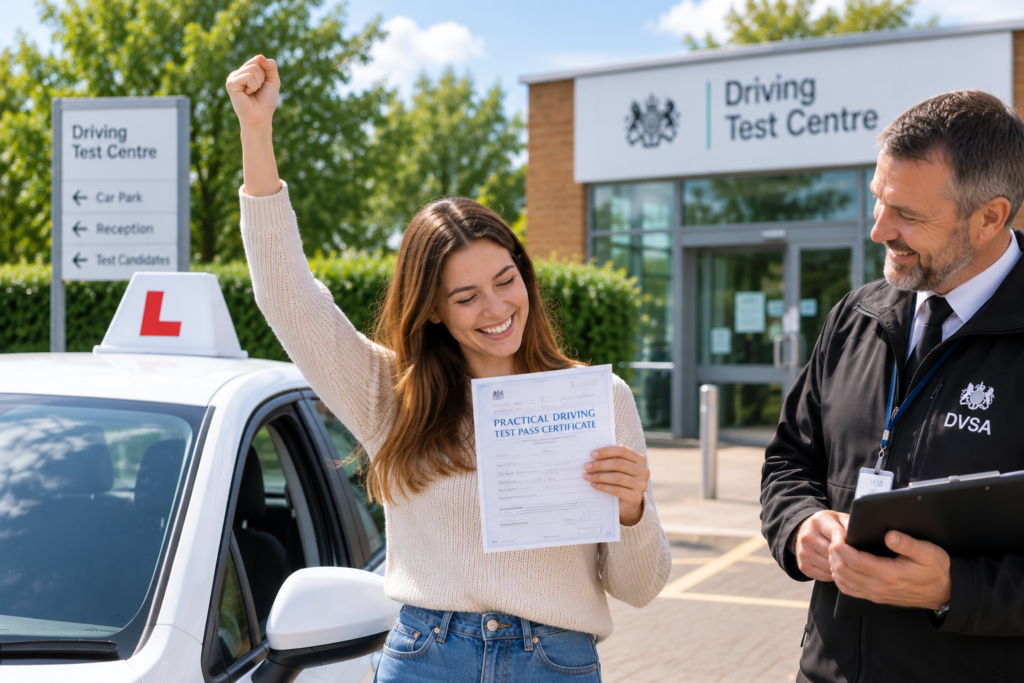
At the end of the test, your examiner will tell you whether you’ve passed or failed and explain your result.
Your test result will show the driving faults recorded, along with any serious or dangerous faults.
The official GOV.UK guidance says the email you receive after the test will show what driving, serious or dangerous faults you made.
This can be useful even if you pass.
If you want to understand what different faults mean and what you can be marked for, see our guide to Driving Test Faults.
If you pass with several faults relating to junctions or mirrors, your instructor can help you work on those areas so that you continue improving after you’ve passed.
Don’t try to count your faults during the test
This is one of the most important things to remember.
You might think:
“I think that’s two minors now.”
Then:
“Was that another one?”
Then:
“That’s probably five…”
Before you know it, you’re mentally running your own little driving test spreadsheet while approaching a roundabout. Not ideal.
Your examiner is responsible for recording your faults.
You are responsible for driving.
If you make a mistake, deal with it safely and move on.
You could still pass.
If you’re worried about making mistakes on test day, our guide to Driving Test Nerves explains how to stay calm and avoid letting one mistake affect the rest of your drive.
What if I think my result is wrong?
If you’re concerned about your test result, you can get more information from the official GOV.UK guidance and discuss the result with your driving instructor.
The result itself is based on the examiner’s assessment during the test.
If you failed, your result can help show which areas need more work before you book another test.
DVSA recommends discussing your result with your instructor so you can focus your practice on the skills that need improving.
Driving test marking sheet: quick summary
Here’s the important stuff to remember:
- The old paper marking sheet has been replaced by a Digital Test Report for normal examiner-recorded results.
- Examiners now record test results digitally on a tablet.
- This did not change how driving tests are assessed.
- Driving faults are often called minors.
- You can have up to 15 driving faults and still pass.
- One serious fault means a fail.
- One dangerous fault means a fail.
- The examiner records faults under the appropriate areas of the Digital Test Report.
- One or both show-me/tell-me questions wrong results in one driving fault.
- A stall does not automatically mean a fail.
- The examiner may record faults without you noticing.
- Your test result shows the faults recorded and helps you understand what to practise.
Final thoughts
The driving test marking sheet might look complicated when you first see one, but you don’t actually need to understand every box on it to pass your test.
Your examiner is looking at the overall standard of your driving and recording faults where appropriate.
Your job is much simpler.
Drive safely.
Look ahead.
Make good decisions.
Use your mirrors.
Stay calm when something doesn’t go perfectly.
And if you make a mistake, don’t assume you’ve failed.
One mistake can simply be one mistake.
Keep driving.
More Help With Your Driving Test
Once you understand how the marking works, these guides can help you prepare for the test itself:
- Driving Test Faults – understand driving faults, serious faults and dangerous faults, and how they affect your result.
- Driving Test Tips – practical tips to help you feel prepared and drive confidently on test day.
- Driving Test Checklist – make sure you know what to bring and what to check before your test.
- Show Me Tell Me Questions – practise the vehicle safety questions you could be asked during your test.
- Driving Test Manoeuvres: learn how the different manoeuvres work and practise them before your test.
For other useful information, see the GOV.UK guide to understanding your driving test result and the DVSA examiner guidance on finding and recording faults on the Digital Test Report.