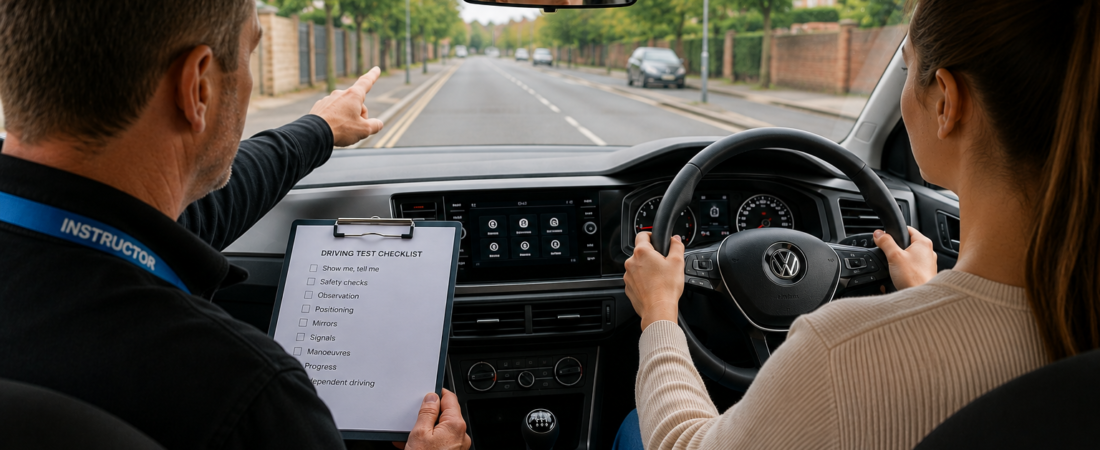
Having your driving test booked can make everything suddenly feel a lot more real.
You might be driving perfectly well during lessons, but as the test gets closer, you start wondering:
Am I actually ready? What if I make a silly mistake? What if I get nervous? What does the examiner really look for?
The good news is that you don’t need to drive perfectly to pass your driving test.
You need to demonstrate that you can drive safely, legally and independently, while showing good awareness of what’s happening around you. Wondering what happens on your driving test? Read our What Happens On A Driving Test guide to give you everything you need to know.
Here are some practical driving test tips to help you prepare and give yourself the best possible chance of passing.
1. Make sure you’re comfortably at test standard
One of the biggest mistakes learners make is treating the test date as the point at which they need to reach test standard.
Ideally, you want to make sure you’re test ready before the day of your driving test.
Why?
Because test-day nerves can affect your driving. You might make decisions slightly differently, become more hesitant, or make the occasional mistake that you wouldn’t normally make during a lesson.
If you’re only just at test standard, a small dip in your driving on the day could be enough to make the difference between passing and failing.
If you’re consistently driving above test standard beforehand, you’ve given yourself a much better safety margin.
Ask yourself:
- Can I drive for a reasonable period without my instructor prompting me?
- Am I consistently making safe decisions?
- Do I spot hazards early enough?
- Are my observations becoming automatic?
- Can I deal with unfamiliar roads and situations?
- Can I recover safely if something unexpected happens?
- Can I complete manoeuvres without needing constant help?
You don’t need to feel completely confident.
Feeling nervous is perfectly normal.
What matters is whether your driving remains safe and controlled despite the nerves.
If you’re still relying heavily on your instructor to tell you what to do, it may be worth having an honest conversation about whether you’re ready for the test.
If you’re still unsure, our Am I Ready For My Driving Test? guide can help you work through the key things to consider before booking.
2. Practise driving independently
Independent driving is an important part of the driving test, and it’s worth practising properly rather than treating it as something you’ll somehow manage on the day.
Your examiner may ask you to follow:
- Sat nav directions
- Traffic signs
- A combination of directions and signs
The important thing isn’t whether you take the perfect route.
The examiner isn’t testing your ability to navigate like a human sat nav.
If you miss a turn, don’t panic.
Missing a direction isn’t automatically a driving fault.
For example, imagine you’re approaching a roundabout and realise you’ve gone the wrong way. If you select the correct lane for the direction you’re actually going, use the appropriate signal and negotiate the roundabout safely, you may not receive a fault at all.
And even if you do go the wrong way, the examiner can help you get back onto the correct route.
What you shouldn’t do is make a sudden or unsafe manoeuvre because you’re worried about going the wrong way.
A safe wrong turn is far better than an unsafe attempt to correct yourself.
3. Look well ahead
Good observation isn’t simply about looking in your mirrors.
You need to be looking well ahead and constantly building a picture of what’s happening around you.
Look for things such as:
- Pedestrians
- Cyclists
- Parked vehicles
- Junctions
- Traffic lights
- Road signs
- Vehicles emerging from side roads
- Bus stops
- Narrow roads
- Changes in speed limits
- Potential hazards around bends
The earlier you spot something, the more time you have to respond.
One of the most useful driving test tips is to develop this forward-planning habit during every lesson.
For example, if you see a parked car 100 metres ahead, don’t wait until you’re right next to it before deciding what to do.
Start thinking early:
What’s behind me? Is anything coming towards me? Do I need to change position? Will I need to slow down?
That forward planning is one of the biggest differences between simply controlling a car and demonstrating good driving.
4. Don’t rush at junctions
Junctions are an area where nerves can cause learners to rush.
You might feel pressure to “get on with it”, particularly if there’s traffic waiting behind you.
Don’t.
Take the time you need to make a safe decision. A common driving test fault is not observing correctly at junctions so this driving test tip is an important one!
Before emerging, make sure you’ve properly assessed what’s happening and that you have enough visibility to proceed safely.
If your view is restricted, don’t guess.
Move forward carefully when appropriate to improve your view.
A driver behind you waiting for a few extra seconds is far less important than making a safe decision.
Read on for more driving test tips…
5. Remember your mirrors
Mirror checks should be useful, not simply something you perform because you think the examiner is watching.
Before changing speed, direction or position, ask yourself:
Who might be affected by what I’m about to do?
Your mirrors help you answer that question.
Pay particular attention before:
- Moving off
- Changing lanes
- Changing direction
- Moving around parked vehicles
- Slowing down significantly
- Overtaking
- Turning
- Moving back into a lane
And if you’re wearing sunglasses on your test, don’t worry that the examiner won’t be able to see your mirror checks.
Examiners are used to learners wearing sunglasses and can still assess whether you’re checking your mirrors.
Don’t feel that you need to exaggerate your head movements to prove that you’re looking.
6. Get comfortable with the manoeuvres
You don’t know exactly which manoeuvre you’ll be asked to perform on your test, so you should be comfortable with all of the possible manoeuvres.
The key words here are control and safety.
Don’t try to complete a manoeuvre as quickly as possible.
An examiner would much rather see a slow, controlled reverse into a bay with thorough observations and a correction, than someone who ends up perfectly in the middle of the bay first time but has driven too quickly and made hardly any observations. This is one of my top driving test tips for manoeuvres.
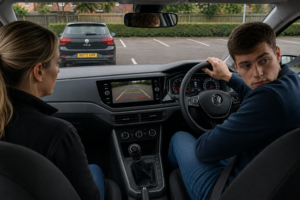
Taking your time is not a problem.
If you need to stop and reassess, do so when it’s safe.
And remember that you are allowed to correct your position.
A correction isn’t automatically a fail.
What matters is that you remain in control and make sure it’s safe before continuing.
You can practise each manoeuvre in more detail in our Driving Test Manoeuvres guides.
7. Don’t let one mistake ruin the rest of your test
This is one of the most important driving test tips.
It’s something I see all the time when I do mock tests.
A learner makes a small mistake that may have resulted in a driving fault.
Instead of putting it behind them and carrying on, they become focused on the mistake.
Then, because they’re thinking about what just happened, they approach the next roundabout too quickly or even go over the speed limit.
The original mistake might have been a minor issue.
The distraction afterwards can create a much bigger problem.
You don’t necessarily know what the examiner has recorded.
Even if you’ve made a driving fault, the test isn’t automatically over.
Take a breath, reset and concentrate on the road ahead.
Think:
That happened. It’s done. What’s the next thing I need to deal with?
A calm recovery is far more useful than replaying the mistake in your head.
If you find that nerves make it difficult to move on from mistakes, our guide to Driving Test Nerves has more practical advice for staying calm and focused.
8. Don’t drive differently just because you’re being tested
One of the biggest causes of test-day problems is trying to become a completely different driver.
Suddenly you’re checking mirrors ten times, driving painfully slowly and overthinking every decision.
Or, in the opposite direction, you start driving too quickly because you’re worried that you’ll receive faults for not making enough progress.
Remember what the examiner is looking for: evidence that you can drive safely and legally.
You can only make progress when it is safe to do so.
Even if you’re driving on a national speed limit road, that doesn’t mean you should automatically be driving at 60 mph.
If the road conditions, visibility, traffic or hazards mean that 60 mph isn’t appropriate, don’t do it.
Your speed should always be appropriate for the conditions.
Try to drive in the same safe, controlled way you’ve practised.
9. If something doesn’t feel right, trust your instincts
If you’re approaching a situation and something doesn’t feel right, don’t ignore that feeling just because you’re worried about what the examiner might think.
Your instinct may be telling you that you’ve missed something.
Slow down if appropriate.
Take another look.
Give yourself time to work out what’s happening.
The examiner wants to see safe decision-making, not unnecessary risk-taking.
If something doesn’t feel right, go with your gut and prioritise safety.
10. Get plenty of experience on different roads
Driving the same familiar routes over and over again can make you feel confident without necessarily preparing you for the test.
Try to experience different environments.
For example:
- Busy town centres
- Rural roads
- Dual carriageways
- Multi-lane roundabouts
- Residential areas
- Narrow roads
- Roads with parked cars
- Busy junctions
- Different speed limits
These are the kinds of situations where good driving test tips can make a real difference, because they help you become more adaptable rather than simply memorising familiar routes.
The test could take you somewhere you’ve never driven before.
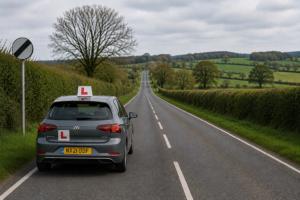
That’s why experience and adaptability are so important.
11. Practise when you’re nervous
If every drive you do is completely relaxed, you may get a shock when test-day nerves arrive.
It’s useful to occasionally recreate test conditions.
Ask your instructor to do mock tests with you.
A proper mock test can help you practise driving independently while someone assesses your driving without giving you the normal prompts and help you’d receive during a lesson.
You could also ask your instructor to make the mock test as realistic as possible, including the briefing, independent driving and manoeuvre.
The aim isn’t to make yourself anxious.
These driving test tips are about preparing yourself to stay calm and make safe decisions when it matters.
It’s to practise continuing to drive safely when you don’t feel completely comfortable.
12. Get your test-day basics right
Don’t underestimate the simple stuff.
Before your test:
- Get a decent night’s sleep if possible.
- Eat something if you normally do.
- Give yourself plenty of time.
- Check where you’re going.
- Make sure you have everything you need.
- Check your car if using your own
- Avoid arriving at the test centre already stressed and rushing.
Our Driving Test Checklist covers the main things to have ready before test day. Not sure what to bring? Find out exactly what to take in our What To Take On Your Driving Test guide. And see what the Driving Test Car Requirements are if you are using your own car for the driving test.

One thing that’s worth checking before the day of your test is how early you can arrive at your particular test centre.
Some centres only want candidates arriving around 5 or 10 minutes before their test because of limited parking and the need to avoid congestion in the car park.
Top driving test tip – Don’t assume that arriving half an hour early is always helpful.
Check the arrangements for your test centre and plan accordingly.
13. If something unexpected happens, prioritise safety
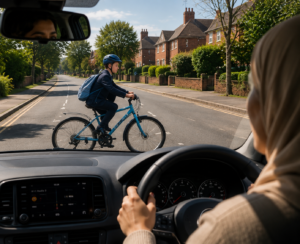
Real driving doesn’t happen in a bubble.
A pedestrian might step towards the road.
A cyclist might move out.
Someone might pull out unexpectedly.
A vehicle might make a strange manoeuvre.
Don’t worry about whether the situation looks “messy”.
The examiner wants to see how you respond.
Slow down when necessary.
Create space.
Communicate clearly.
And give yourself time to make a safe decision.
14. Remember what the test is actually asking you to demonstrate
Ultimately, your driving test is about showing that you can drive safely and legally without your instructor sitting beside you.
You don’t have to:
- Impress the examiner
- Drive perfectly
- Know every road
- Never make a mistake
- Complete everything at lightning speed
You do need to demonstrate safe decision-making, good observation, appropriate speed, effective control and consideration for other road users.
That’s a much more achievable goal.
If you want to understand exactly what your examiner is assessing, see our guide to the Driving Test Marking Sheet.
Keeping these driving test tips in mind can help you focus on what the examiner actually needs to see.
Final driving test tips
When the test starts, try not to think about passing.
Think about driving safely and legally.
Look ahead.
Observe.
Plan.
Make safe decisions.
Keep your speed appropriate.
If something goes wrong, deal with it and move on.
Don’t try to impress the examiner and don’t take risks because you think you’re expected to make more progress.
You don’t need to drive perfectly to pass your driving test. You need to demonstrate that you can drive safely, legally and independently.
And if you can do that consistently before your test, you’ll give yourself the best possible chance of doing it when the examiner is sitting beside you. Just follow the driving test tips above 🚗
Want to know the key things to check before your practical test? Check out our driving test checklist to leave nothing to chance and get yourself fully prepared.
More Driving Test Help:
- Driving Test Faults Explained: Understand how driving faults, serious faults and dangerous faults are recorded and how they affect your result
- Driving Test Nerves: Find practical ways to manage nerves and stay calm and focused during your test
- How The Test Is Marked: Learn what your examiner is looking for and how your driving is recorded during the test
- Driving Test Checklist: Make sure you have everything ready and know what to check before test day
- Driving Test Manoeuvres: Learn how the different driving test manoeuvres work and what to focus on when practising them
- Show Me Tell Me: Practise the vehicle safety questions you could be asked during your practical driving test
Book your driving test here