Wondering “Am I ready for my driving test?” is completely normal. It can be difficult to judge whether you’re genuinely ready or whether you simply need a few more lessons to feel confident.
Being ready does not mean driving perfectly every time. Everyone makes occasional mistakes, including experienced drivers. What matters is whether you can drive safely, independently and consistently, without your instructor having to regularly step in. Find out what to expect on your driving test in our What Happens on a Driving Test guide.
Your practical driving test lasts around 35 minutes and covers eyesight, vehicle safety questions, general driving ability, independent driving and a reversing exercise.
So how can you tell whether you’re ready?
Here are 10 signs to look for.
1. You can drive safely without constant prompts
One of the biggest signs that you’re ready for your driving test is that your instructor no longer needs to talk you through every situation.
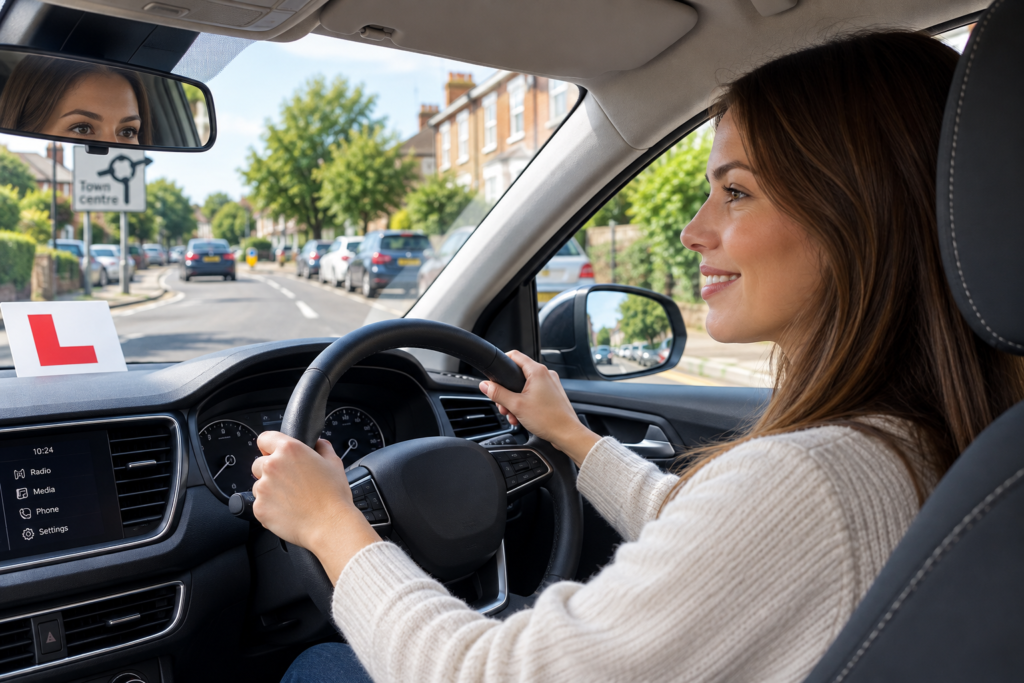
You should be making your own decisions about:
- When it is safe to emerge
- When to slow down
- Which lane to use
- When to signal
- When to check your mirrors
- How to deal with developing hazards
- When it is safe to move off
Your instructor should increasingly be able to sit back and let you drive.
That doesn’t mean they should never say anything. A prompt or reminder occasionally is normal. The important question is whether you can recognise and deal with situations yourself.
If you still regularly hear things like “check your mirrors”, “slow down”, “look left” or “watch that junction” before you’ve noticed the situation yourself, you may need more practice.
2. You can drive independently
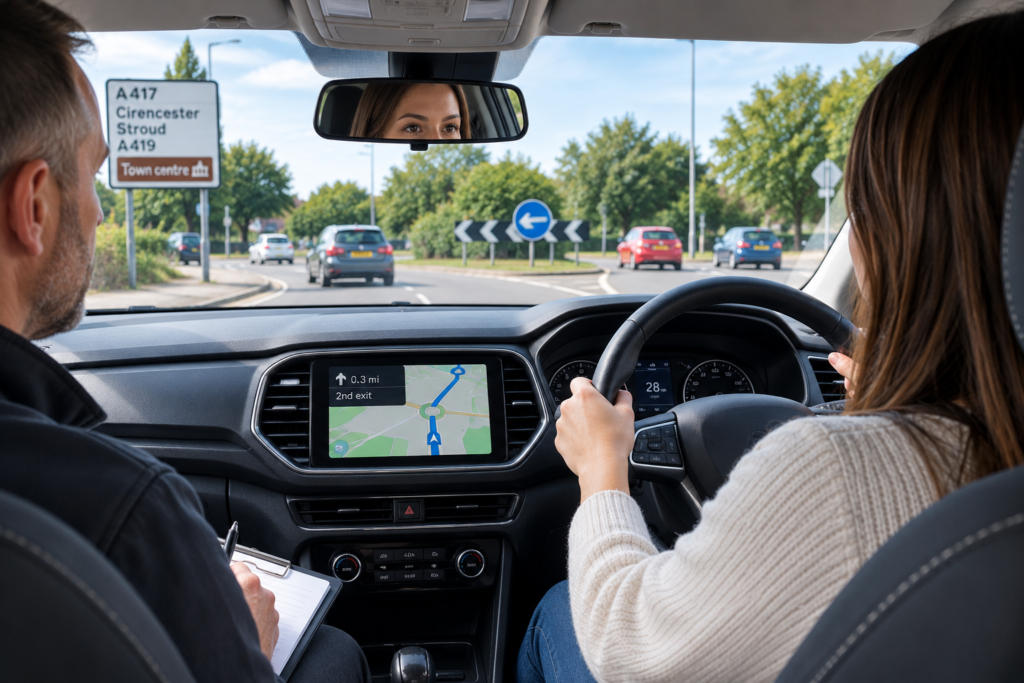
Independent driving is an important part of the practical test.
During your test, you’ll drive independently for around 20 to 35 minutes, following either a sat nav, traffic signs or a combination of both. The examiner sets up the sat nav for you.
You don’t need to know the test route.
Instead, you need to show that you can:
- Follow directions
- Read road signs
- Plan ahead
- Choose the correct lane
- Make safe decisions
- Continue driving safely if you make a wrong turn
And don’t panic about getting lost.
If you take a wrong turning, you won’t automatically receive a fault. The examiner will help you get back on route if necessary.
A good test of your readiness is to have a lesson where your instructor gives you minimal help and lets you deal with the route yourself.
3. Your junctions are consistently safe
Junctions are one of the biggest areas where learners can pick up faults.
You should be able to approach and negotiate different types of junction without needing instructions for every one.
That includes:
- T-junctions
- Give Way junctions
- Stop junctions
- Major-to-minor junctions
- Roundabouts
- Traffic-light junctions
- Busy urban junctions
You’re looking for consistent decision-making, rather than one perfect lesson.
You should be able to judge speed and gaps, make effective observations and proceed when it is safe.
If you regularly hesitate unnecessarily or need your instructor to tell you when to go, keep practising before booking your test.
4. Your mirror use happens naturally
You shouldn’t have to consciously think:
“I haven’t checked my mirrors for 30 seconds.”
Good mirror use should become part of your normal driving routine.
You should be checking appropriately before situations such as:
- Changing speed
- Changing direction
- Changing lanes
- Moving off
- Stopping
- Overtaking or passing parked vehicles
- Moving around hazards
The examiner isn’t looking for a rigid mirror-checking routine. They’re looking for effective observation and safe decision-making.
If your instructor rarely needs to remind you about your mirrors, that’s a very good sign.
5. You can handle different road and traffic conditions
Being ready isn’t just about being brilliant on the roads you know.
Your test could take you through a mixture of roads and traffic conditions, so you need to be able to adapt.
You should have experience driving on things such as:
- Quiet residential roads
- Busy urban roads
- Dual carriageways
- Roundabouts
- Narrow roads
- Roads with parked cars
- Different speed limits
- Busy junctions
- Different weather and lighting conditions where possible
The aim is not to memorise particular routes.
It’s to develop the ability to look ahead, recognise hazards and adjust your driving to whatever appears in front of you.
6. You can complete the manoeuvres without being talked through them
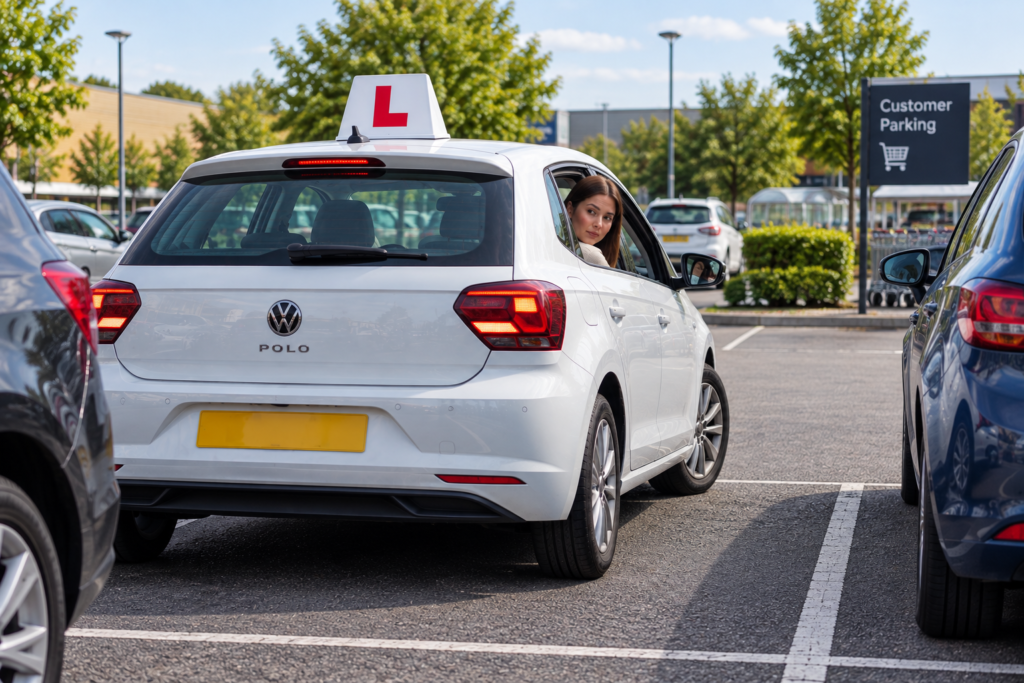
You don’t need to perform a manoeuvre perfectly every single time.
You do need to understand how to complete the manoeuvres safely and independently.
The examiner will ask you to carry out one reversing exercise. This can include a parallel park, parking in a bay or pulling up on the right and reversing for around two car lengths before rejoining traffic.
You should be comfortable with:
- Setting the car up correctly
- Making effective observations
- Controlling the car at low speed
- Stopping if necessary
- Correcting your position safely
- Finishing the manoeuvre under control
If your instructor still needs to tell you exactly when to steer, when to stop or where to look, you probably need more practice.
If you make a small correction yourself and continue safely, that’s very different.
7. You can deal with mistakes without falling apart
This is a big one.
A test doesn’t require you to drive perfectly.
You might:
- Take a wrong turning
- Stall
- Misjudge something and need to correct it
- Make a minor positioning error
- Miss a signal
- Feel that you’ve made a horrible mistake
The important thing is what happens next.
During the practical test, you can carry on after making a mistake. A mistake does not automatically mean you’ve failed.
If you make an error, the best response is usually to stay calm, concentrate on the next situation and continue driving safely.
If one small mistake causes you to lose concentration for the next five minutes, work on that before test day.
You can read more about this in our Driving Test Nerves and Driving Test Faults guides.
8. Your driving faults are generally low and manageable
You don’t have to finish every lesson with zero faults.
In fact, chasing perfection can sometimes make learners more nervous.
To pass your practical test, you can have up to 15 driving faults, provided you have no serious or dangerous faults.
However, don’t use the 15-fault limit as your target.
If you’re regularly picking up lots of driving faults in lessons, especially the same faults repeatedly, you’re probably not ready yet.
A better question is:
Are my mistakes becoming less frequent, less serious and less repetitive?
Your instructor should be able to identify the areas that still need work.
9. You can answer the show me tell me questions
The show me tell me questions shouldn’t be something you leave until the night before your test.
You’ll be asked two vehicle safety questions:
- One tell me question before you start driving
- One show me question while you’re driving
The show me question involves demonstrating a vehicle safety check while maintaining control of the car.
You don’t need to recite complicated textbook answers.
You should understand what you’re checking, how you’d carry out the check and why it matters.
If you haven’t already done so, practise all the official questions.
Our Show Me Tell Me Questions guide covers them all.
10. Your instructor genuinely thinks you’re ready
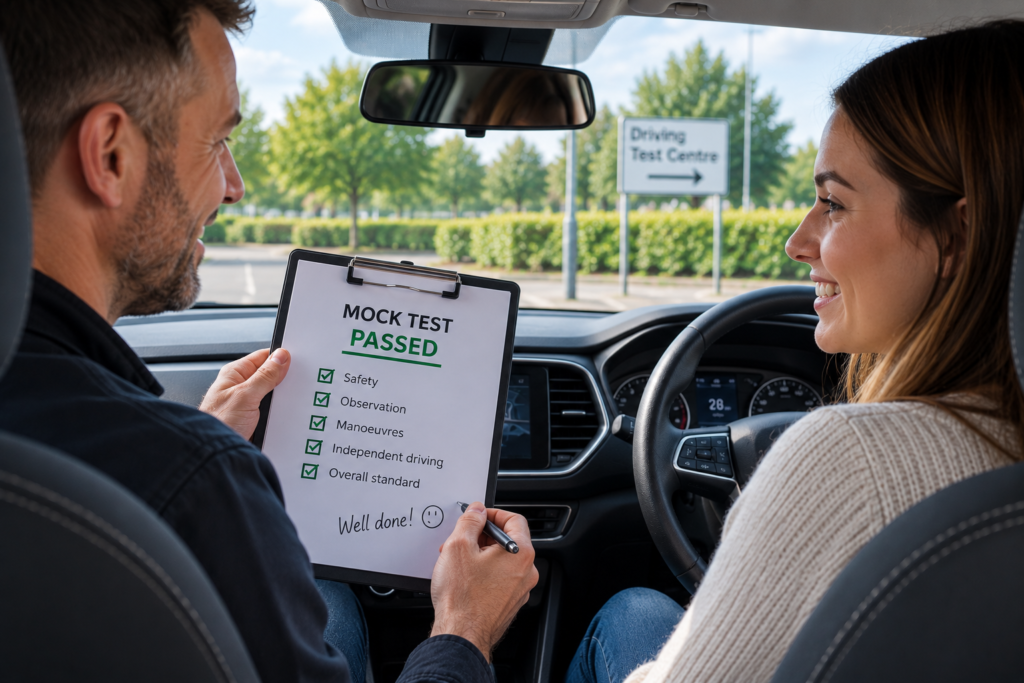
This is probably the most important sign of all.
Your instructor sees your driving regularly and can compare your performance across different lessons, roads and situations.
They should be able to tell you honestly whether you’re ready for the test.
Ideally, you should be able to complete a mock test without your instructor having to rescue you from situations.
You don’t necessarily need a completely fault-free mock test.
Instead, look at the overall picture:
Can you drive safely and independently for the whole lesson?
If the answer is yes, you’re getting very close.
What if I feel nervous but I’m driving well?
Feeling nervous does not automatically mean you’re not ready.
You can be completely capable of passing and still feel nervous about the test.
The important distinction is between:
“I’m nervous because this matters to me.”
and:
“I’m nervous because I don’t yet know what to do.”
The first is completely normal.
The second suggests you may need more practice.
Should I book my driving test if I’m not completely confident?
If nerves are your main concern, don’t assume you need weeks of extra lessons. You may simply need to practise driving in test-like conditions and become more comfortable with the pressure.
Our Driving Test Nerves guide has more tips for dealing with this.
You don’t have to wait until you feel 100% confident.
Very few learners reach a point where they think:
“I know absolutely everything and nothing could possibly go wrong.”
Driving is unpredictable. Even experienced drivers encounter situations they haven’t seen before.
What you want is competence, independence and consistency.
A simple test-readiness checklist
In 2026, the rules around booking and changing car driving tests have also changed. Learners must book their own car test, and you should choose a date you realistically expect to be ready for. You can currently make two changes to your appointment, subject to the booking rules.
That makes it even more important to have an honest conversation with your instructor before choosing your test date.
Before booking your practical test, ask yourself:
☐ Can I drive without regular prompts?
☐ Can I deal safely with unfamiliar roads?
☐ Can I make my own decisions at junctions?
☐ Do I use my mirrors effectively?
☐ Can I follow directions independently?
☐ Can I complete all the manoeuvres safely?
☐ Can I recover calmly after making a mistake?
☐ Are my driving faults generally low and improving?
☐ Do I know the show me tell me questions?
☐ Does my instructor believe I’m ready?
If you can confidently tick most of these boxes, you’re probably getting close.
If several boxes are still causing problems, that’s useful information rather than a failure. You now know what to work on.
The bottom line
So, am I ready for my driving test?
You’re probably ready when you can drive safely and independently without relying on your instructor to rescue you, even when the road, traffic or situation isn’t exactly what you expected.
You don’t need perfect driving.
You need to demonstrate that you can make safe decisions, control the car, anticipate what’s happening around you and deal with normal mistakes without losing concentration.
And if you’re still unsure, ask your instructor to give you a full mock test with as little help as possible.
That will usually tell you much more than simply asking yourself whether you feel confident.
To know what to bring to your driving test read our What to Take on Your Driving Test guide. Taking your driving test in your own car? See our Driving Test Car Requirements guide to see exactly what your car needs.
More driving test help
If you’re getting close to test day, these guides can help:
- Driving Test Tips: practical ways to improve your chances of passing
- Driving Test Checklist: what to prepare before test day
- Driving Test Faults: understand minors, serious and dangerous faults
- Driving Test Nerves: how to stay calm and focused
- Driving Test Marking Sheet: understand how your examiner records your test
- Theory Test Guide: your complete guide to the theory test
Your goal isn’t to drive perfectly. It’s to show the examiner that you’re ready to drive safely on your own.