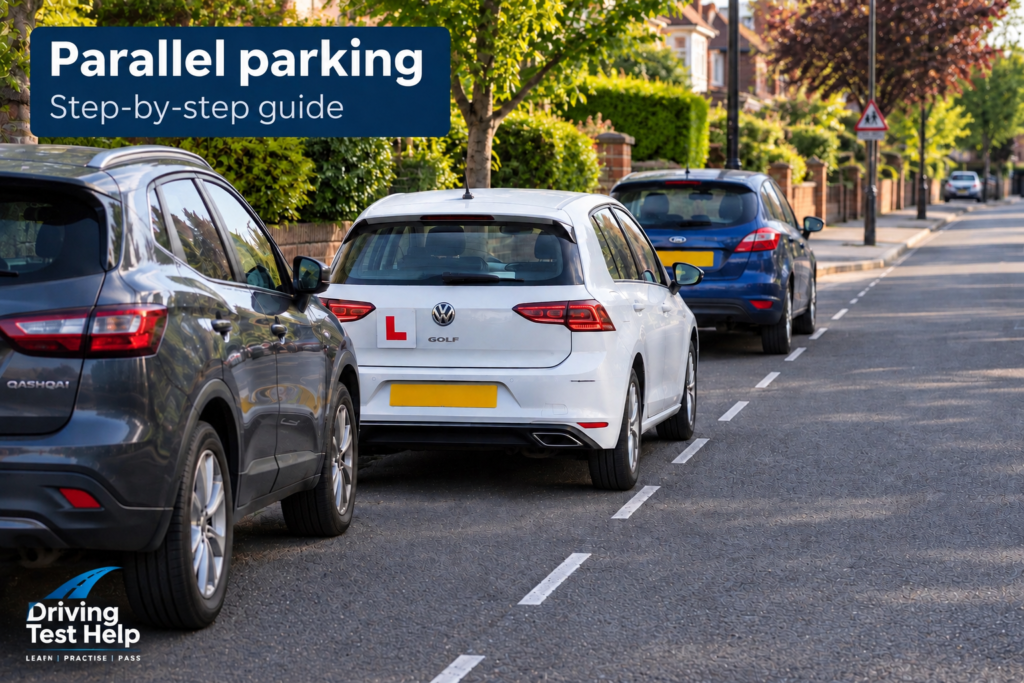
Parallel parking is one of the reversing exercises you could be asked to complete on your UK practical driving test. To know more about what to expect on test day read our What Happens on Your Driving Test guide.
It can seem complicated at first, but you don’t need to rely on memorising a series of exact steering movements. The most important things are good observation, accurate positioning, smooth control and understanding how your car moves when reversing.
With enough practice, parallel parking should become a controlled and repeatable manoeuvre rather than something you have to worry about on test day.
What is parallel parking?
Parallel parking involves pulling up alongside a parked vehicle and then reversing into the space behind it, finishing reasonably close and parallel to the kerb. The reason you reverse into the space is that, when the space is smaller, such as between two parked cars, there wouldn’t be enough room to straighten the car if you drove in forwards.
On the driving test, the examiner will ask you to pull up on the left before a parked vehicle. You’ll then drive alongside the vehicle and reverse into the space behind it.
You may be asked to park behind one parked vehicle or between two parked vehicles.
The examiner is looking at how safely and accurately you complete the manoeuvre, rather than whether you follow a particular method.
What happens in the parallel parking test?
If you’re asked to complete a parallel park, the examiner will give you clear instructions about where they want you to stop and what to do.
You’ll normally:
- Pull up safely before the parked vehicle.
- Drive alongside it and position your car appropriately.
- Reverse into the space.
- Use effective all-round observation throughout.
- Make any necessary steering or positioning corrections.
- Finish reasonably close and parallel to the kerb.
You don’t have to get everything perfect on the first attempt. Corrections are allowed as long as you remain safe and in control.
Before you start
Good preparation makes parallel parking much easier.
Before moving into the space, make sure you have:
- Checked your mirrors.
- Checked your blind spots where appropriate.
- Considered pedestrians, cyclists and other road users.
- Positioned your car safely alongside the parked vehicle.
- Selected reverse and prepared to move slowly.
- Understood where you want the car to finish.
Don’t rush into the manoeuvre just because the examiner has given you the instruction.
Take a moment to get yourself properly positioned before you start reversing.
Step-by-step parallel parking
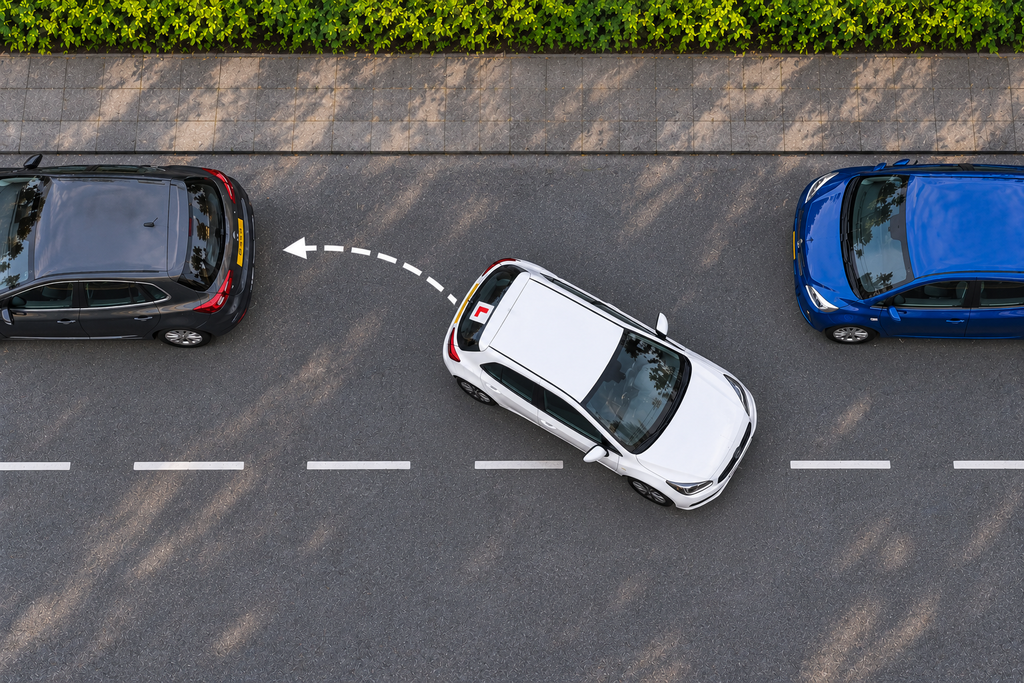
There are different ways of teaching parallel parking, and your instructor may have a method that works particularly well for your car. Taking your own car on your driving test? Find out the exact car requirements in our Driving Test Car Requirements guide.
The important thing is to understand the principles rather than becoming dependent on one exact reference point.
1. Pull up safely
When the examiner asks you to pull up before the parked vehicle, choose a safe position that gives you enough room to carry out the manoeuvre.
Use your mirrors and observations before stopping.
Make sure you’re not too close to the parked vehicle and leave yourself enough space to reverse into the available area.
2. Check all around before reversing
Before you begin reversing, carry out effective observations.
Look around the vehicle and check for:
- Pedestrians
- Cyclists
- Cars approaching from behind
- Vehicles pulling out
- Children or other vulnerable road users
- Anything that could enter your path
Don’t rely solely on your mirrors.
Your examiner wants to see that you’re aware of what’s happening around the vehicle before and during the manoeuvre.
3. Start reversing slowly
Once it’s safe, begin reversing at a slow, controlled speed.
Slow speed gives you more time to observe and make adjustments.
There’s no benefit in trying to complete parallel parking quickly.
Keep checking around you as the vehicle moves. Your observations should continue throughout the manoeuvre rather than happening only at the beginning.
4. Steer into the space
As you reverse, steer the car so that it moves into the available space.
The exact steering point will depend on the vehicle you’re driving, the size of the space and your starting position.
This is why learning a method based entirely on fixed reference points can cause problems if you take your test in a different car.
Instead, learn to recognise what the car is doing.
Watch where the front and rear of the vehicle are moving and adjust your steering accordingly.
5. Straighten the car
As the car moves further into the space, you’ll need to straighten your steering and continue reversing until the vehicle is positioned appropriately.
Keep checking your surroundings.
Don’t become so focused on getting the car perfectly positioned that you stop observing what’s happening around you.
6. Make a correction if needed
If your first attempt doesn’t leave you in the right position, don’t panic.
You can make a correction.
Stop if necessary, reassess your position and make another controlled movement.
A sensible correction is much better than trying to force the car into position because you’re worried about making a mistake.
The examiner is assessing your control and observation, not whether you can perform the manoeuvre without ever adjusting the car.
7. Finish safely
Once you’ve completed the manoeuvre, make sure the car is:
- Reasonably close to the kerb
- Parallel to the kerb
- Safely positioned
- Under control
Apply the parking brake if appropriate and wait for the examiner’s next instruction.
Your observations during parallel parking
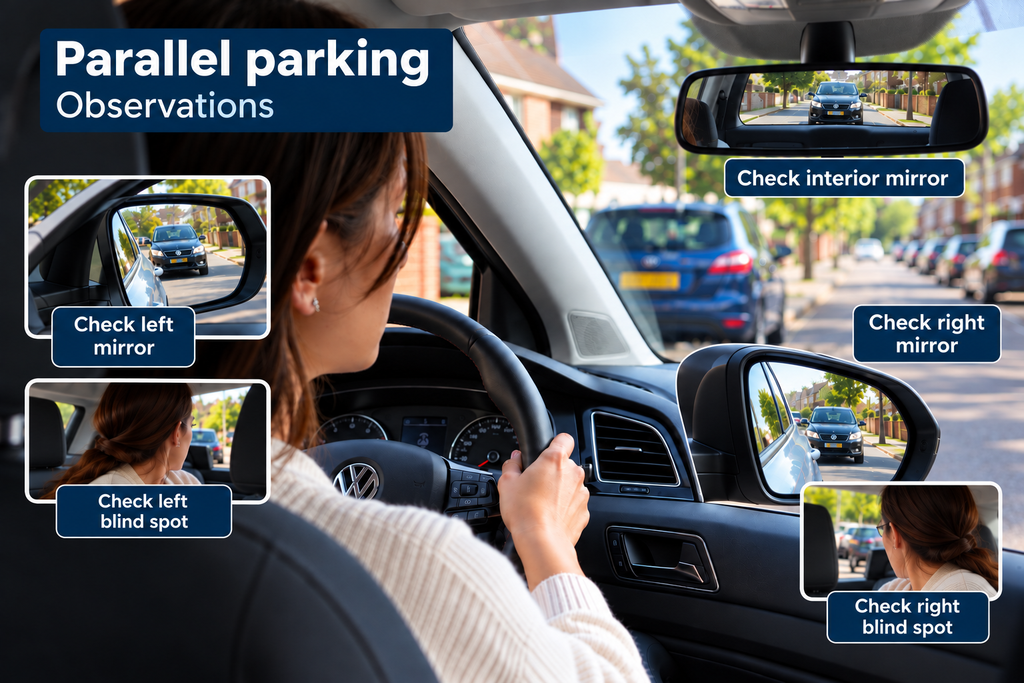
Observation is one of the most important parts of parallel parking.
You need to remain aware of what’s happening around the vehicle throughout the manoeuvre.
For example, a pedestrian could walk towards the road while you’re reversing, or another vehicle could approach from behind.
If something changes, be prepared to stop.
Don’t simply continue because you started the manoeuvre a few seconds earlier.
Safe observation comes before completing the manoeuvre.
If you need to stop because another road user approaches, that’s perfectly sensible. Wait until it’s safe before continuing.
How fast should you reverse?
Slowly.
There’s no prize for completing parallel parking in record time. 🏎️❌
A slow, controlled speed gives you much more time to:
- Observe
- Steer
- Assess your position
- Spot hazards
- Make corrections
However, slow doesn’t mean unnecessarily hesitant.
Once you’ve established that it’s safe, keep the car moving smoothly and under control.
Your aim is to demonstrate that you can control the vehicle confidently while reversing.
Can you correct your position?
Yes.
You don’t have to get the manoeuvre perfect in one continuous movement.
If you realise that your positioning isn’t right, you can stop and make a correction.
For example, you might need to:
- Steer again to improve your angle.
- Move slightly forwards before continuing backwards.
- Reposition the car within the available space.
The key is that corrections should be safe, controlled and properly observed.
Repeated repositioning because you’re struggling to control the car could contribute to a driving fault, so the goal is to develop a method that you can perform confidently.
Common parallel parking mistakes
Here are some of the problems learners commonly experience when practising parallel parking.
Not checking properly before reversing
Starting the manoeuvre without effective observation can put other road users at risk.
Always make sure it’s safe before you begin.
Focusing only on one reference point
Reference points can be useful when learning, but don’t become completely dependent on them.
Your starting position and the size of the car can change the way the manoeuvre looks.
Learn to understand the movement of your vehicle as well.
Reversing too quickly
Speed makes the manoeuvre harder because you have less time to observe and react.
Keep the car under control.
Getting too close to the kerb
Touching or driving over the kerb can result in a fault, depending on what happens and how the situation develops.
Practise judging the distance between your vehicle and the kerb rather than trying to memorise one exact position.
Forgetting about the front of the car
When reversing and steering, the front of your car moves out in the opposite direction to the rear.
Keep thinking about the whole vehicle, not just the part you’re watching in the mirrors.
Stopping your observations
Don’t let your attention become completely focused on the steering.
Keep checking around the vehicle throughout the manoeuvre.
Panicking after a mistake
A small positioning mistake doesn’t automatically mean you’ve failed.
Stay calm, make the situation safe and correct your position if necessary. For help with handling your nerves on your driving test see our guide to Staying Calm on Test Day.
What faults can you get during parallel parking?
The examiner assesses your driving throughout the manoeuvre.
Possible driving faults can include problems with:
- Control
- Observation
- Positioning
- Repeated corrections
- Responding appropriately to other road users
For example, poor control that causes you to repeatedly reposition the car could result in a driving fault.
Touching or driving onto the pavement can also result in a fault, depending on the circumstances.
More serious problems can occur if your actions create a significant danger or the examiner has to intervene.
Remember that one driving fault doesn’t automatically mean you’ve failed.
To understand how faults are marked and how many you can have, see our guide toDriving Test Faults.
What if another vehicle approaches?
If another vehicle approaches while you’re reversing, don’t feel pressured to finish the manoeuvre.
Your priority is to keep the situation safe.
If necessary:
- Stop the car.
- Check what’s happening around you.
- Allow the other vehicle to pass if appropriate.
- Continue only when it’s safe.
The same applies to pedestrians and cyclists.
Being prepared to stop shows that you’re thinking about what’s happening around you rather than simply concentrating on completing the manoeuvre.
How to practise parallel parking
The best way to become confident with parallel parking is to practise it repeatedly in different situations.
Start somewhere quiet where you have plenty of space.
Focus on:
- Getting your initial position right.
- Reversing slowly.
- Understanding how steering changes the car’s direction.
- Keeping effective observations.
- Finishing parallel to the kerb.
- Making controlled corrections.
Once you’re comfortable, practise in more realistic locations with parked vehicles and normal road conditions.
Your instructor can also vary the starting position and available space so that you don’t become dependent on performing the manoeuvre in exactly the same location every time.
Practise without relying entirely on reference points
Reference points can be helpful when you’re learning, but try to understand why you’re steering at a particular point.
If you understand how the car moves when you turn the steering wheel while reversing, you’ll be much better equipped to deal with different cars, different spaces and slightly different starting positions.
That understanding is much more useful than memorising a complicated sequence.
Parallel parking checklist
Before finishing your manoeuvre, ask yourself:
☐ Did I check around the car before reversing?
☐ Am I reversing slowly and under control?
☐ Am I continuing to observe throughout the manoeuvre?
☐ Have I considered pedestrians, cyclists and other vehicles?
☐ Am I keeping the whole vehicle in mind?
☐ Have I made a correction if necessary?
☐ Am I reasonably close to the kerb?
☐ Am I reasonably parallel with the kerb?
☐ Is the car safely positioned before I finish?
If you can consistently complete these points during practice, your parallel parking should become much more comfortable.
Final parallel parking tips
Parallel parking doesn’t need to be perfect.
The examiner isn’t looking for a particular steering routine or expecting you to perform a manoeuvre like a driving instructor demonstration.
They’re looking for safe, controlled and responsible driving.
Remember these key points:
- Take your time.
- Position the car carefully before reversing.
- Make effective all-round observations.
- Reverse slowly.
- Understand how your car moves.
- Don’t panic if you need to correct your position.
- Keep watching for other road users.
- Finish reasonably close and parallel to the kerb.
The more you practise, the less you’ll have to think about each individual movement.
The aim isn’t to perform a perfect manoeuvre. It’s to show that you can control your car, observe properly and make safe decisions while reversing.
Ready to practise?
Parallel parking is just one of the manoeuvres you could be asked to complete on your driving test.
Explore our Driving Test Manoeuvres guide to learn about the other reversing exercises, including Bay Parking and Pull Up on the Right & Reverse.
You can also read our other guides on What to Take on Your Driving Test, Driving Test Faults Explained, Driving Test Tips, How The Test is Marked and Am I Ready for My Driving Test? to help you prepare for the whole test.
For more information about the UK driving test click here. And more about the skills needed to pass the test here.