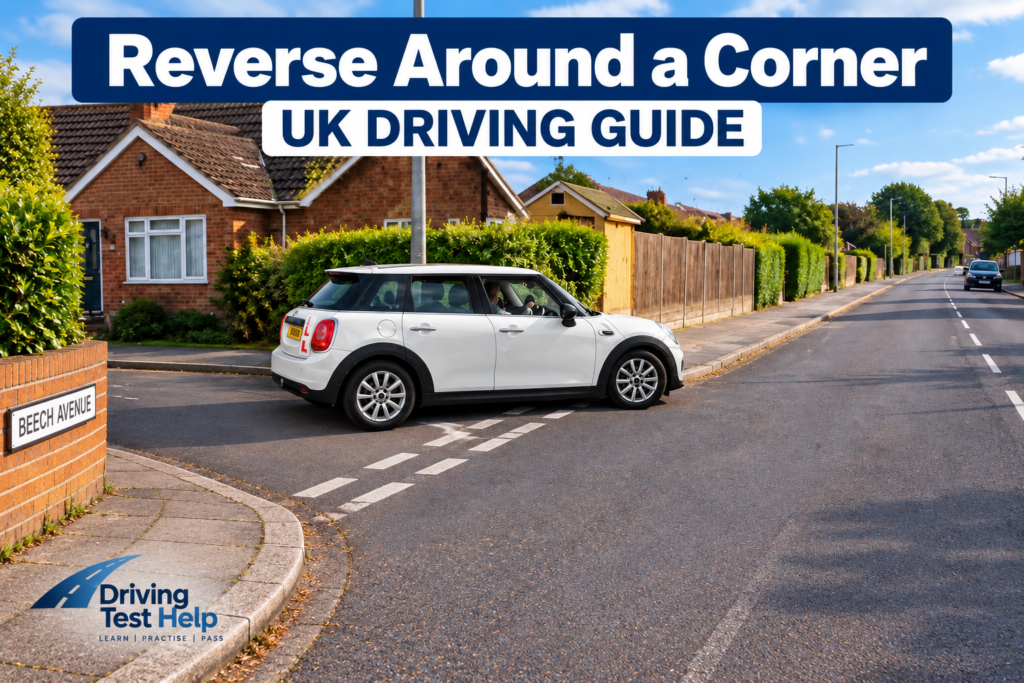
Reverse around a corner is a useful driving skill that teaches you how to reverse safely while steering around a bend. Although it is no longer one of the specific reversing manoeuvres used in the standard UK car practical driving test, the skills involved are still valuable for everyday driving. To find out what to expect on your driving test see our What Happens on a Driving Test guide.
You may also find yourself needing to use the technique if you take a wrong turn or encounter an unexpected obstruction or road closure.
Is Reverse Around a Corner Still in the Driving Test?
No. Reverse around a corner is not currently one of the specific reversing exercises you are asked to complete during the standard UK car practical driving test.
The reversing exercises used in the test are:
- Bay parking
- Parallel parking
- Pull up on the right and reverse approximately two car lengths
However, that doesn’t mean reverse around a corner is a skill you can ignore.
Why Is It Still Worth Learning?
Imagine you’re on your driving test and following the examiner’s directions when you discover that the road ahead is unexpectedly closed. Or perhaps you realise you’ve taken the wrong route and need to turn around.
You shouldn’t panic or make a sudden manoeuvre. The examiner may give you new directions, and you may need to find a safe place to turn around.
If a suitable side road is available, reversing around a corner can be one way of turning the car around safely, provided the road is suitable and you can do it with good control and observation.
Even outside the test, there will be times when you need to reverse around a corner to turn around, get into a road, driveway or other restricted space.
So, even though you aren’t specifically tested on it, it’s still worth learning just in case you need the skill during your test or in everyday driving.
How to Reverse Around a Corner
Step 1: Find a Suitable Corner
The exact technique can vary depending on the road, corner and vehicle, but the most important principles are slow speed, good observation and accurate steering.
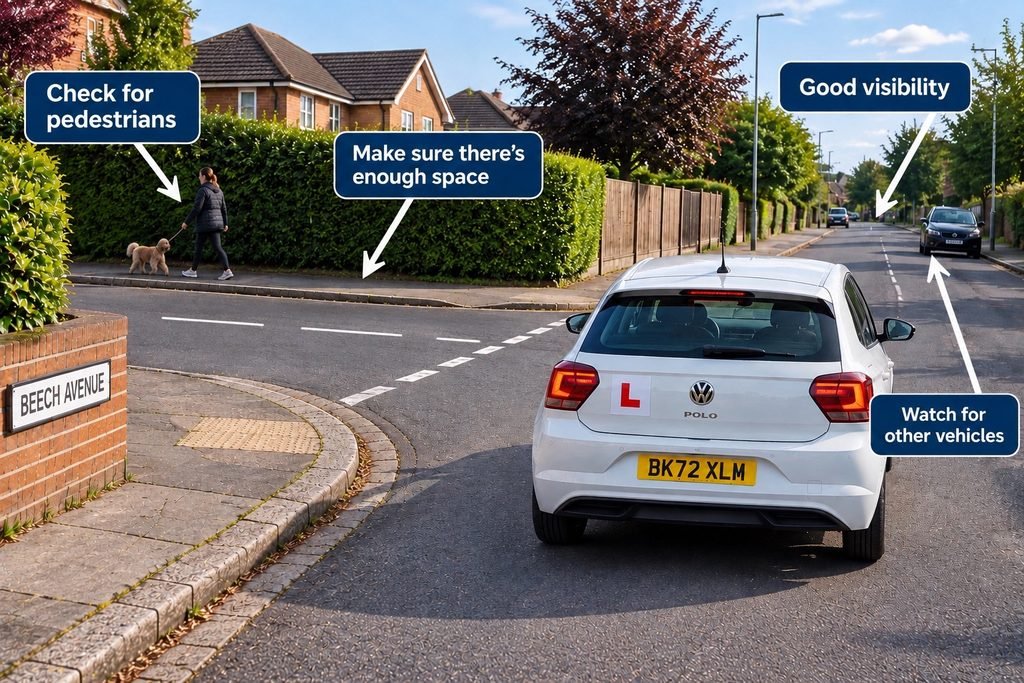
Before starting, make sure the road and corner are suitable for reversing.
Look for:
- A reasonably quiet road
- Good visibility
- No parked vehicles blocking your path
- No pedestrians or cyclists creating a hazard
- Enough room to complete the manoeuvre safely
- No restrictions that would make reversing inappropriate
Don’t simply start reversing because a corner is available. You are responsible for making sure it is safe to do so.
Step 2: Position Your Car
Position the car appropriately before you begin reversing.
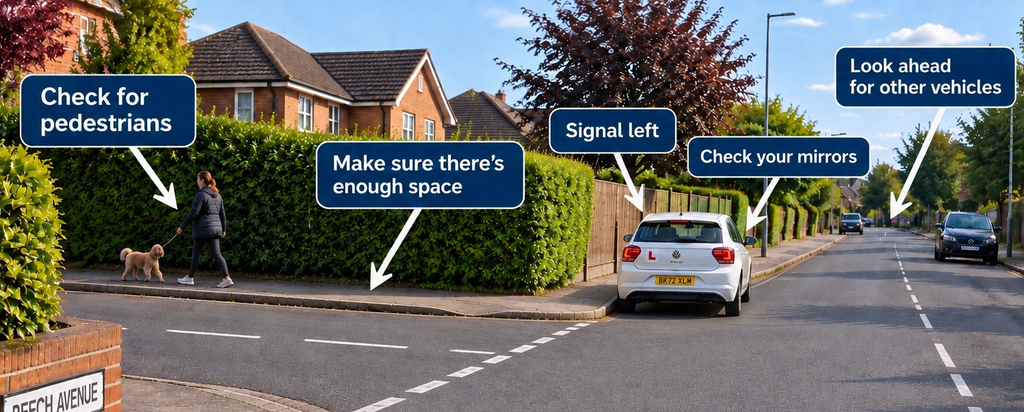
You should normally be reasonably close to the kerb without being so close that you risk hitting it.
Take your time getting into position. A good starting position makes the rest of the manoeuvre much easier.
Step 3: Check All Around
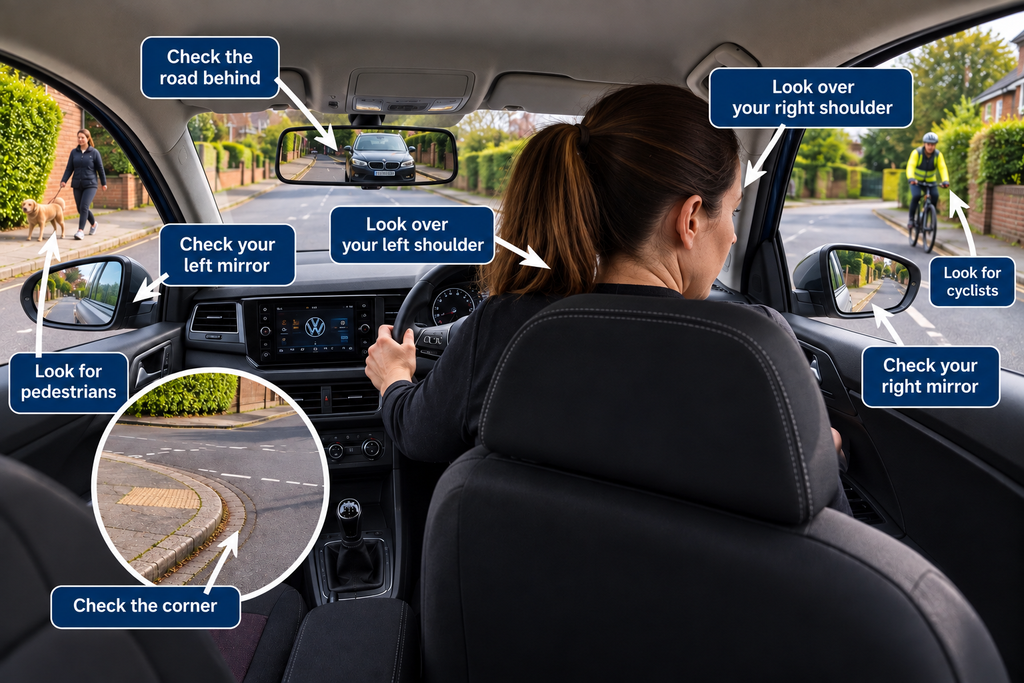
Observation is one of the most important parts of reversing.
Before moving, check:
- Your mirrors
- Over both shoulders
- The road behind you
- The corner you are about to reverse around
- Pavements and driveways
- For pedestrians, cyclists and other road users
Don’t rely entirely on your mirrors. Look directly around the car as well.
Step 4: Start Reversing Slowly
If anything changes while you’re reversing, stop and reassess.
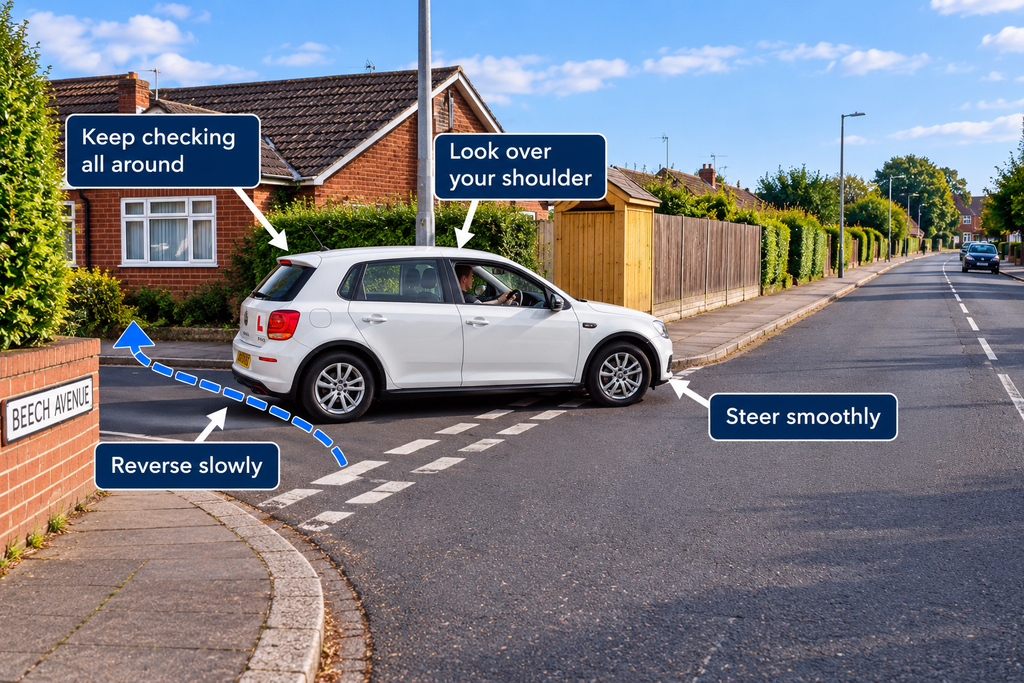
Select reverse and begin moving at a very slow, controlled speed.
You should be able to stop almost immediately if necessary.
Keep checking all around as you move. Your attention shouldn’t be fixed solely on where the back of the car is going.
A common mistake is reversing too quickly and then trying to correct the steering. Slow speed gives you much more time to observe and make small adjustments.
Step 5: Steer Around the Corner
As the rear of the car approaches the corner, begin steering in the appropriate direction to follow the road.
Use small, controlled steering movements rather than making a dramatic turn all at once.
Keep looking where the car is going and continue checking your surroundings.
If the car isn’t following the line you want, stop if necessary and make an adjustment. There is no prize for trying to complete the whole manoeuvre in one perfectly smooth movement.
Step 6: Straighten the Car
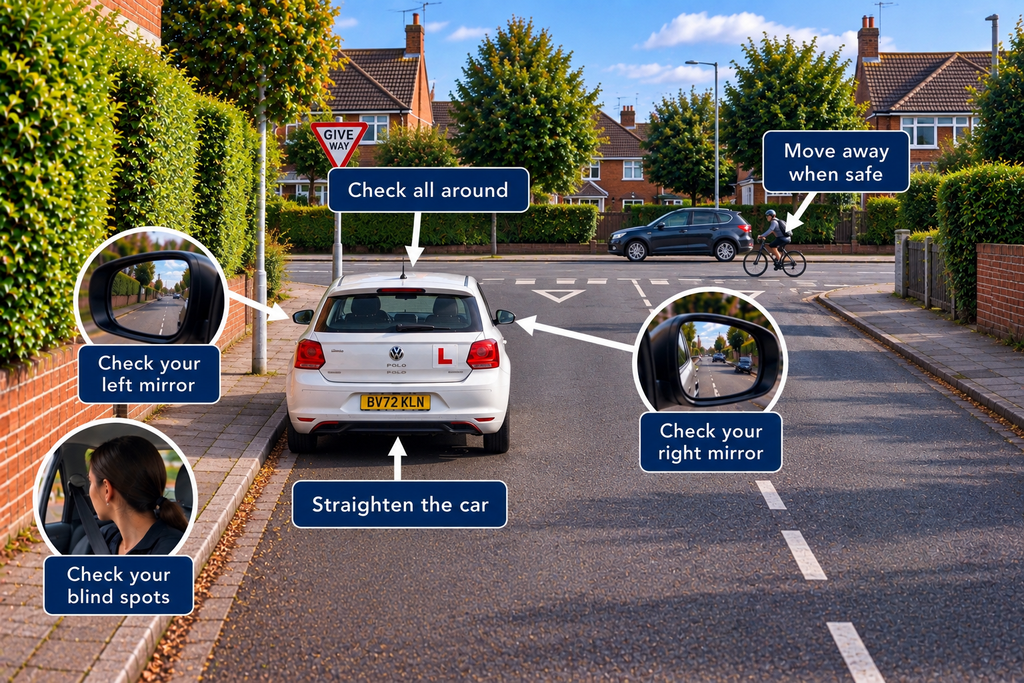
Once you’ve successfully reversed around the corner, gradually steer to straighten the car.
Continue reversing slowly while checking your surroundings.
Make sure the car is positioned safely on the new road and that you aren’t drifting too close to the kerb.
Step 7: Stop Safely
Once you’re in a suitable position, stop the car safely.
Apply the parking brake if appropriate and select neutral or park, depending on your vehicle.
If you’re turning around as part of a journey, don’t rush into moving forwards again. Take another set of observations before continuing.
What If You Need to Stop?
Stopping during a reversing manoeuvre is completely sensible if the situation changes.
For example, you might notice:
- A pedestrian approaching
- A cyclist coming past
- A vehicle entering the road
- Someone walking behind the car
- A car approaching around the corner
Stop and wait if necessary.
Good reversing isn’t about completing the manoeuvre without stopping. It’s about keeping the vehicle under control and responding safely to what’s happening around you.
Common Mistakes When Reversing Around a Corner
Reversing too quickly
Speed makes observation and steering corrections much harder.
Keep the car moving slowly enough that you can stop immediately if needed.
Not checking all around
Don’t just watch the rear of the car.
Pedestrians, cyclists and other vehicles can appear from several directions.
Turning the steering wheel too early
Turning too soon can cause the car to cut across the kerb.
Take your time and steer progressively.
Turning too late
If you wait too long, the car may swing too wide and end up too far from the kerb.
Getting too close to the kerb
A small gap is fine, but don’t allow the wheels to mount the kerb.
Focusing only on the kerb
It’s easy to become obsessed with keeping the car in the “right” position and forget about what’s happening around you.
Observation comes first.
Panicking when something changes
If another road user appears, don’t try to squeeze through.
Stop, observe and decide what is safest.
Do You Have to Be Perfect?
No.
When you’re learning to reverse around a corner, your first attempts probably won’t look particularly elegant. That’s normal.
The aim is to develop the ability to:
- Control the car at a slow speed
- Steer accurately
- Observe effectively
- Recognise hazards
- Stop when necessary
- Make safe corrections
It’s much more important to develop good control and observation than to memorise a rigid steering routine.
Reverse Around a Corner: Quick Checklist
Before and during the manoeuvre, remember:
☑️ Find a suitable and safe corner
☑️ Position the car correctly
☑️ Check all around before reversing
☑️ Reverse slowly
☑️ Keep checking your surroundings
☑️ Steer smoothly around the corner
☑️ Stop if the situation changes
☑️ Straighten the car once you’re around
☑️ Check all around again before moving away
Top Tips
1. Take it slowly
The slower you go, the more time you have to observe and correct the car.
2. Don’t rely on a steering formula
Different corners and cars require different amounts of steering.
3. Keep looking around
Your mirrors are useful, but they don’t show you everything.
4. Stop if you’re unsure
If something doesn’t look right, stopping gives you time to reassess.
5. Practise on different corners
Once you’re comfortable, practise on corners with different widths, road layouts and levels of visibility.
6. Think about safety rather than perfection
The goal isn’t to make the manoeuvre look fancy. It’s to move the car safely and under control.
Final Thoughts
You might never be specifically asked to reverse around a corner on your driving test, but that doesn’t make the skill useless.
Driving doesn’t always go exactly to plan. You could take a wrong turn, meet an unexpected road closure or simply find yourself somewhere that requires you to turn around.
Learning how to reverse around a corner gives you another useful tool for dealing with those situations safely.
Learn it, practise it, and you’ll have one more useful skill in your driving toolbox. 🚗
More Driving Test Manoeuvres & Guides
Want to practise the other manoeuvres and prepare for your driving test? Take a look at our other guides:
- Pull Up on the Right and Reverse: Learn how to complete this driving test manoeuvre safely, including positioning, observation and reversing approximately two car lengths.
- Parallel Parking: A step-by-step guide to parallel parking, with tips to help you position the car accurately and safely.
- Bay Parking: Learn the different ways to approach bay parking and how to make accurate adjustments.
- What to Take on Your Driving Test: What to bring with you on the day so you’re fully prepared.
- Driving Test Car Requirements: What your car needs for the test if you’re taking your own car.
- Driving Test Tips: More practical advice to help you prepare for your UK driving test and avoid common mistakes.
- Driving Test Checklist: A useful checklist of the things to practise and remember before the big day.
Still not sure whether you’re ready for your test? Our other driving test guides can help you build your confidence, understand what the examiner is looking for and identify areas you may need to practise.